Application
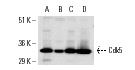
Western blot analysis of Cdk5 expression in NIH/3T3 (A), RAW 264.7 (B), MM-142 (C) and WEHI-231 (D) nuclear extracts.Application
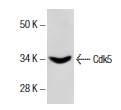
Western blot analysis of Cdk5 expression in Jurkat nuclear extract.| Product Name | Cdk5 Antibody (H-291) |
|---|---|
| Antibody Type | Primary Antibodies |
| Antigen Alias | epitope corresponding to amino acids 1-291 representing full length Cdk5 of human origin |
| Modification Notes | Cell cycle progression is controlled in part by a family of cyclin proteins and cyclin dependent kinases (Cdks). Cdk proteins work in concert with the cyclins to phosphorylate key substrates involved in each phase of cell cycle progression. Another family of proteins, Cdk inhibitors, also plays a role in regulating cell cycle by binding to cyclin-Cdk complexes and modulating their activity. Several Cdk proteins have been identified, including Cdk2-Cdk8, PCTAIRE-1–3, PITALRE and PITSLRE. Cdk5 is thought to be involved in the G1-S transition of the cell cycle and is highly expressed in mature neurons. Activity of Cdk5 increases significantly during neuronal differentiation. Cdk5 has been postulated to be a neurofilament or tau protein kinase, based on its ability to phosphorylate these proteins in vitro. |
| Clonality | Polyclonal |
|---|---|
| Isotype | IgG |
| Host Species | Rabbit |
| Tested Applications | WBIPIFELISA |
| recommended for detection of Cdk5 of mouse, rat and human origin by WB, IP, IF and ELISA minimal cross-reactivity with other cyclin dependent kinases also reactive with additional species, including equine, bovine, porcine and avian: |
|
| Species Reactivity | HumanMouseRat |
| Concentration | 1mg/ml |
| Purification | Affinity purified |
| Alternative Names | epitope corresponding to amino acids 1-291 representing full length Cdk5 of human origin |
|---|---|
| Tissue Specificity | epitope corresponding to amino acids 1-291 representing full length Cdk5 of human origin |
| Entrez Gene | 1020 |
|---|
Application
Western blot analysis of Cdk5 expression in NIH/3T3 (A), RAW 264.7 (B), MM-142 (C) and WEHI-231 (D) nuclear extracts.
Application
Western blot analysis of Cdk5 expression in Jurkat nuclear extract.| Application Notes | recommended for detection of Cdk5 of mouse, rat and human origin by WB, IP, IF and ELISA minimal cross-reactivity with other cyclin dependent kinases also reactive with additional species, including equine, bovine, porcine and avian: |
|---|
| Form | Liquid |
|---|---|
| Storage Instructions | For short-term storage, store at 4° C. For long-term storage, aliquot and store at -20ºC or below. Avoid multiple freeze-thaw cycles. |
| Storage Buffer | phosphate buffered saline , pH 7.4, 150mM NaCl, 0.02% sodium azide and 50% glycerol. |


