Application
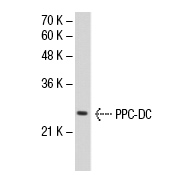
Western blot analysis of PPC-DC expression in Hep G2 whole cell lysate.| Product Name | PPC-DC Antibody (T-16) |
|---|---|
| Antibody Type | Primary Antibodies |
| Antigen Alias | raised against PPC-DC of human origin |
| Modification Notes | Phosphopantothenoylcysteine decarboxylase (PPC-DC) is a 204 amino acid protein that plays a role in the biosynthesis of coenzyme A (CoA) from pantothenate (vitamin B). CoA is an essential cofactor in all living organisms and is involved in several key biochemical pathyways, including the tricarboxylic acid cycle and fatty acid metabolism. Altered CoA levels are associated with aberrant mitosis and meiosis in flies and the neurodegenerative Hallervorden-Spatz syndrome in humans. The biosynthesis of CoA from pantothenate requires several steps: the phosphorylation of pantothenate, the conversion of 4’-phosphopantothenate to 4'-phosphopantetheine, the adenylation by phosphopantetheine adenylyltransferase to form dephospho-CoA and the phosphorylation by dephospho-CoA kinase to form CoA. PPC-DC plays a direct role in this pathway by converting 4'-phosphopantothenate into 4'-phosphopantetheine. Potentially forming a homotrimer, PPC-DC has 2 named isoforms produced by alternative splicing. |
| Clonality | Polyclonal |
|---|---|
| Isotype | IgG |
| Host Species | Rabbit |
| Tested Applications | WBIPELISA |
| recommended for detection of PPC-DC of human and canine origin by WB, IP and ELISA: |
|
| Species Reactivity | HumanMouseRat |
| Concentration | 1mg/ml |
| Purification | Affinity purified |
| Alternative Names | raised against PPC-DC of human origin |
|---|---|
| Tissue Specificity | raised against PPC-DC of human origin |
| Entrez Gene | 60490 |
|---|
Application
Western blot analysis of PPC-DC expression in Hep G2 whole cell lysate.| Application Notes | recommended for detection of PPC-DC of human and canine origin by WB, IP and ELISA: |
|---|
| Form | Liquid |
|---|---|
| Storage Instructions | For short-term storage, store at 4° C. For long-term storage, aliquot and store at -20ºC or below. Avoid multiple freeze-thaw cycles. |
| Storage Buffer | phosphate buffered saline , pH 7.4, 150mM NaCl, 0.02% sodium azide and 50% glycerol. |


