Application
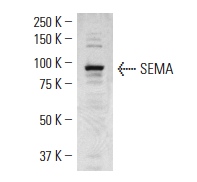
Western blot analysis of SEMA expression in rat brain tissue extract.| Product Name | SEMA Antibody (H-300) |
|---|---|
| Antibody Type | Primary Antibodies |
| Antigen Alias | epitope corresponding to amino acids 103-402 of SEMA3A of human origin |
| Modification Notes | Semaphorins (SEMAs) comprise a family of cell surface and secreted proteins that are conserved from insects to humans. Members of this family of proteins are approximately 750 amino acids in length (including signal sequences) and are defined by a conserved extracellular “semaphorin” domain of approximately 500 amino acids containing 14-16 cysteines, many blocks of conserved sequences and no obvious repeats. Secreted and cell-bound semaphorins are known to chemically attract and repel the growth of neural axons, guiding the development of intricate networks of neural tissue. In addition to their role in axonal guidance, semaphorins have also been associated with the progression of cancer. Many semaphorins bind to the receptors neuropilin and neuropilin-2, thus competing with VEGF for this interaction, which ultimately results in the suppression of angiogenesis. The loss of functional semaphorins to compete with VEGF may play an important role in tumor progression. |
| Clonality | Polyclonal |
|---|---|
| Isotype | IgG |
| Host Species | Rabbit |
| Tested Applications | WBIPIFELISA |
| recommended for detection of Semaphorin family members of mouse, rat and human origin by WB, IP, IF and ELISA also reactive with additional species, including equine, canine, bovine, porcine and avian: |
|
| Species Reactivity | HumanMouseRat |
| Concentration | 1mg/ml |
| Purification | Affinity purified |
| Alternative Names | epitope corresponding to amino acids 103-402 of SEMA3A of human origin |
|---|---|
| Tissue Specificity | epitope corresponding to amino acids 103-402 of SEMA3A of human origin |
| Entrez Gene | 10371 |
|---|
Application
Western blot analysis of SEMA expression in rat brain tissue extract.| Application Notes | recommended for detection of Semaphorin family members of mouse, rat and human origin by WB, IP, IF and ELISA also reactive with additional species, including equine, canine, bovine, porcine and avian: |
|---|
| Form | Liquid |
|---|---|
| Storage Instructions | For short-term storage, store at 4° C. For long-term storage, aliquot and store at -20ºC or below. Avoid multiple freeze-thaw cycles. |
| Storage Buffer | phosphate buffered saline , pH 7.4, 150mM NaCl, 0.02% sodium azide and 50% glycerol. |


