Application
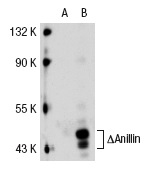
Western blot analysis of truncated Anillin expression in non-transfected: (A) and truncated human Anillin transfected: (B) 293T whole cell lysates.| Product Name | Anillin Antibody (H-300) |
|---|---|
| Antibody Type | Primary Antibodies |
| Antigen Alias | epitope corresponding to amino acids 641-940 mapping near the C-terminus of Anillin of human origin |
| Modification Notes | Anillin, also known as scraps homolog, is an evolutionarily conserved Actin- binding protein required for cytokinesis that was first identified in Drosophila melanogaster. Anillin is a ubiquitously expressed protein with highest expression levels in the central nervous system. It is predominantly found in the nucleus and it localizes to the cleavage furrow during cytokinesis, forming a ring with the help of Rac GTPase. During cytokinesis, Anillin interacts with CD2AP and functions to concentrate Rho A and maintain the localization of active Myosin. In Anillin knockout cells the cleavage furrow fails to complete ingression. Anillin expression levels fluctuate with the cell cycle, peaking in mitosis. Before the cell exits into G1, Anillin associates with E-cadherin and is ubiquitinated by the anaphase-promoting complex/cyclosome (APC/C). APC/C recognizes the D-box domain at the N-terminal region of Anillin. Anillin is commonly overexpressed in tumors and may serve as a potential biomarker. |
| Clonality | Polyclonal |
|---|---|
| Isotype | IgG |
| Host Species | Rabbit |
| Tested Applications | WBIPIFELISA |
| recommended for detection of Anillin of mouse, rat and human origin by WB, IP, IF and ELISA also reactive with additional species, including equine, canine, bovine and porcine: |
|
| Species Reactivity | HumanMouseRat |
| Concentration | 1mg/ml |
| Purification | Affinity purified |
| Alternative Names | epitope corresponding to amino acids 641-940 mapping near the C-terminus of Anillin of human origin |
|---|---|
| Tissue Specificity | epitope corresponding to amino acids 641-940 mapping near the C-terminus of Anillin of human origin |
| Entrez Gene | 54443 |
|---|
Application
Western blot analysis of truncated Anillin expression in non-transfected: (A) and truncated human Anillin transfected: (B) 293T whole cell lysates.| Application Notes | recommended for detection of Anillin of mouse, rat and human origin by WB, IP, IF and ELISA also reactive with additional species, including equine, canine, bovine and porcine: |
|---|
| Form | Liquid |
|---|---|
| Storage Instructions | For short-term storage, store at 4° C. For long-term storage, aliquot and store at -20ºC or below. Avoid multiple freeze-thaw cycles. |
| Storage Buffer | phosphate buffered saline , pH 7.4, 150mM NaCl, 0.02% sodium azide and 50% glycerol. |


