Application
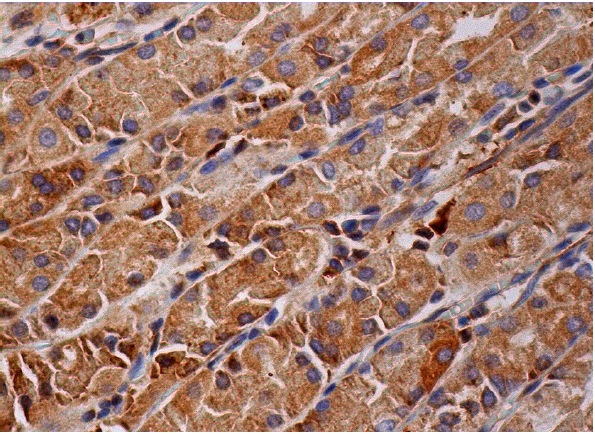
Immunoperoxidase staining of formalin fixed, paraffin-embedded human upper stomach tissue showing cytoplasmic staining of glandular cells.| Product Name | Keratocan Antibody (H-50) |
|---|---|
| Antibody Type | Primary Antibodies |
| Antigen Alias | epitope corresponding to amino acids 251-300 mapping near the C-terminus of Keratocan of human origin |
| Conjugation | Agarose |
| Modification | Acetylated |
| Modification Notes | Small leucine-rich proteoglycans (SLRPs) such as Decorin, Biglycan, Fibromod-ulin, Keratocan, Lumican and Osteoglycin mediate extracellular matrix organization and are binding partners of TGF?. The Decorin core protein binds to growth factors, intercellular matrix molecules such as Fibronectin and Throm-bospondin, and to the Decorin endocytosis receptor. Fibromodulin is a collagen-binding keratan sulphate proteoglycan that influences adhesion processes of connective tissue and plays a role in fibrillogenesis by regulating collagen fibril spacing and thickness. Keratocan (KTN) develops corneal transparency and maintains the stromal matrix structure. Keratocan is a secreted protein in the extracellular matrix that binds to keratan sulfate chains. Keratocan is mainly detected in the cornea, but can also be expressed in trachea, intestine, ovary, lung and skeletal muscle. Defects in the gene encoding for Keratocan can cause cornea plana 2 (CNA2), an autosomal recessive disorder where the forward convex curvature of the cornea is flattened. |
| Clonality | Polyclonal |
|---|---|
| Isotype | IgG |
| Host Species | Rabbit |
| Tested Applications | ELISAIFIPWB |
| WB:1:100~1:400 IP:1:20~1:100 IF:1:20~1:100 |
|
| Species Reactivity | HumanMouseRat |
| Predicted Reactivity | equine, canine, bovine and porcine |
| Concentration | 1mg/ml |
| Purification | Affinity purified |
| Alternative Names | epitope corresponding to amino acids 251-300 mapping near the C-terminus of Keratocan of human origin |
|---|---|
| Tissue Specificity | epitope corresponding to amino acids 251-300 mapping near the C-terminus of Keratocan of human origin |
| Entrez Gene | 11081 |
|---|
Application
Immunoperoxidase staining of formalin fixed, paraffin-embedded human upper stomach tissue showing cytoplasmic staining of glandular cells.| Application Notes | WB:1:100~1:400 IP:1:20~1:100 IF:1:20~1:100 |
|---|
| Form | Liquid |
|---|---|
| Storage Instructions | For short-term storage, store at 4° C. For long-term storage, aliquot and store at -20ºC or below. Avoid multiple freeze-thaw cycles. |
| Storage Buffer | phosphate buffered saline , pH 7.4, 150mM NaCl, 0.02% sodium azide and 50% glycerol. |


