Application
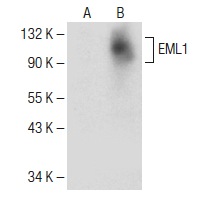
Western blot analysis of EML1 expression in non-transfected: (A) and human EML1 transfected: (B) 293T whole cell lysates.| Product Name | EML1 Antibody (H-61) |
|---|---|
| Antibody Type | Primary Antibodies |
| Antigen Alias | epitope corresponding to amino acids 60-120 mapping within an internal region of EML1 of human origin |
| Modification Notes | Echinoderm microtubule-associated proteins function to modify the assembly dynamics of microtubules by making microtubules slightly longer yet more dynamic. They are classified as ubiquitous due to their expression in most tissues, however, their expression does not occur in the thymus nor the peripheral blood lymphocytes. In the human form of the protein, there is a WD40 domain, also contained in a number of eukaryotic proteins, that carries out functions including signal transduction using adaptor/regulatory modules, pre-mRNA processing and cytoskeleton assembly. EML1 (echinoderm microtubule-associated protein-like 1 or EMAP-1) may be a candidate gene for Usher syndrome type 1A. Usher syndromes (USHs) are a group of genetic disorders consisting of congenital deafness, retinitis pigmentosa, and vestibular dysfunction of variable onset and severity depending on the genetic type. |
| Clonality | Polyclonal |
|---|---|
| Isotype | IgG |
| Host Species | Rabbit |
| Tested Applications | WBIPIFELISA |
| recommended for detection of EML1 of mouse, rat and human origin by WB, IP, IF and ELISA also reactive with additional species, including equine, canine, porcine and avian: |
|
| Species Reactivity | HumanMouseRat |
| Concentration | 1mg/ml |
| Purification | Affinity purified |
| Alternative Names | epitope corresponding to amino acids 60-120 mapping within an internal region of EML1 of human origin |
|---|---|
| Tissue Specificity | epitope corresponding to amino acids 60-120 mapping within an internal region of EML1 of human origin |
| Entrez Gene | 2009 |
|---|
Application
Western blot analysis of EML1 expression in non-transfected: (A) and human EML1 transfected: (B) 293T whole cell lysates.| Application Notes | recommended for detection of EML1 of mouse, rat and human origin by WB, IP, IF and ELISA also reactive with additional species, including equine, canine, porcine and avian: |
|---|
| Form | Liquid |
|---|---|
| Storage Instructions | For short-term storage, store at 4° C. For long-term storage, aliquot and store at -20ºC or below. Avoid multiple freeze-thaw cycles. |
| Storage Buffer | phosphate buffered saline , pH 7.4, 150mM NaCl, 0.02% sodium azide and 50% glycerol. |


