Application
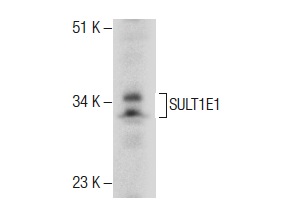
Western blot analysis of SULT1E1 expression in human liver tissue extract.| Product Name | SULT1E1 Antibody (H-40) |
|---|---|
| Antibody Type | Primary Antibodies |
| Antigen Alias | epitope corresponding to amino acids 54-93 mapping within an internal region of SULT1E1 of human origin |
| Modification Notes | The soluble sulfotransferases contribute to the elimination of xenobiotics, the activation of procarcinogens and the regulation of hormones by catalyzing the sulfate conjugation of these substances. Members of the three groups comprising this superfamily (namely SULT1, SULT2 and SULT3) show selectivity to certain substrate compounds. SULT1 sulfotransferases exhibit N-sulfating activities of carcinogenic heterocyclic amines, and are selective toward phenols, whereas SULT2 enzymes prefer hydroxysteroids and SULT3 family members are selective for N-substituted aryl and alicyclic compounds. SULT1E1, also known as STE, is a 294 amino acid member of the SULT1 family. Localized to the cytoplasm and expressed in intestine, liver and kidney, SULT1E1 exists as a homodimer that is thought to control estrogen receptor (ER) levels by sulfurylating free estradiol. Defects in the gene encoding SULT1E1 are associated with an increased risk for endometrial cancer, suggesting a role for SULT1E1 in tumorigenesis. |
| Clonality | Polyclonal |
|---|---|
| Isotype | IgG |
| Host Species | Rabbit |
| Tested Applications | WBIPIFELISA |
| recommended for detection of SULT1E1 of mouse, rat and human origin by WB, IP, IF and ELISA may cross-react with other SULT family members also reactive with additional species, including equine, canine and porcine: |
|
| Species Reactivity | HumanMouseRat |
| Concentration | 1mg/ml |
| Purification | Affinity purified |
| Alternative Names | epitope corresponding to amino acids 54-93 mapping within an internal region of SULT1E1 of human origin |
|---|---|
| Tissue Specificity | epitope corresponding to amino acids 54-93 mapping within an internal region of SULT1E1 of human origin |
| Entrez Gene | 6783 |
|---|
Application
Western blot analysis of SULT1E1 expression in human liver tissue extract.| Application Notes | recommended for detection of SULT1E1 of mouse, rat and human origin by WB, IP, IF and ELISA may cross-react with other SULT family members also reactive with additional species, including equine, canine and porcine: |
|---|
| Form | Liquid |
|---|---|
| Storage Instructions | For short-term storage, store at 4° C. For long-term storage, aliquot and store at -20ºC or below. Avoid multiple freeze-thaw cycles. |
| Storage Buffer | phosphate buffered saline , pH 7.4, 150mM NaCl, 0.02% sodium azide and 50% glycerol. |


