Application
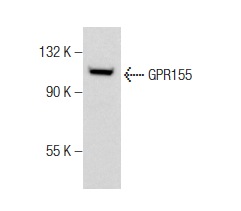
Western blot analysis of GPR155 expression in MCF7 whole cell lysate.Application
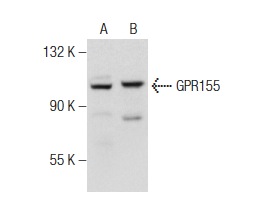
Western blot analysis of GPR155 expression in CCRF-CEM (A) and Hep G2 (B) whole cell lysates.| Product Name | GPR155 Antibody (V-14) |
|---|---|
| Antibody Type | Primary Antibodies |
| Antigen Alias | epitope mapping within an internal region of GPR155 of human origin |
| Modification Notes | G protein-coupled receptors (GPRs), also known as seven transmembrane receptors, heptahelical receptors or 7TM receptors, comprise a superfamily of proteins that play a role in many different stimulus-response pathways. G protein coupled receptors translate extracellular signals into intracellular signals (G protein activation) and they respond to a variety of signaling molecules, such as hormones and neurotransmitters. GPR155 (G protein-coupled receptor 155), also known as DEP.7, PGR22 or DEPDC3, is an 870 amino acid multi-pass membrane protein that contains one DEP domain. The gene encoding GPR155 maps to human chromosome 2, which consists of 237 million bases, encodes over 1,400 genes and makes up approximately 8% of the human genome. A number of genetic diseases are linked to genes on chromosome 2 including Harlequin icthyosis, sitosterolemia and Alström syndrome. |
| Clonality | Polyclonal |
|---|---|
| Isotype | IgG |
| Host Species | Rabbit |
| Tested Applications | WBIPIFELISA |
| recommended for detection of GPR155 of mouse, rat and human origin by WB, IF, IP and ELISA non cross-reactive with other GPR family members: |
|
| Species Reactivity | HumanMouseRat |
| Concentration | 1mg/ml |
| Purification | Affinity purified |
| Alternative Names | epitope mapping within an internal region of GPR155 of human origin |
|---|---|
| Tissue Specificity | epitope mapping within an internal region of GPR155 of human origin |
| Entrez Gene | 151556 |
|---|
Application
Western blot analysis of GPR155 expression in MCF7 whole cell lysate.
Application
Western blot analysis of GPR155 expression in CCRF-CEM (A) and Hep G2 (B) whole cell lysates.| Application Notes | recommended for detection of GPR155 of mouse, rat and human origin by WB, IF, IP and ELISA non cross-reactive with other GPR family members: |
|---|
| Form | Liquid |
|---|---|
| Storage Instructions | For short-term storage, store at 4° C. For long-term storage, aliquot and store at -20ºC or below. Avoid multiple freeze-thaw cycles. |
| Storage Buffer | phosphate buffered saline , pH 7.4, 150mM NaCl, 0.02% sodium azide and 50% glycerol. |


