Application
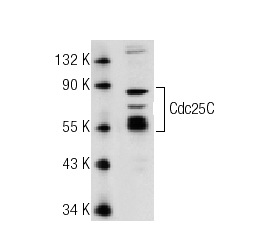
Western blot analysis of Cdc25C expression in Raji whole cell lysate.Application
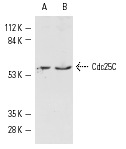
Western blot analysis of Cdc25C expression in KNRK (A) and NIH/3T3 (B) whole cell lysates.| Product Name | Cdc25C Antibody (C-20) |
|---|---|
| Antibody Type | Primary Antibodies |
| Antigen Alias | epitope mapping at the C-terminus of Cdc25C of human origin |
| Modification Notes | Cell cycle events are regulated by the sequential activation and deactivation of cyclin-dependent kinases (Cdks), including Cdk2 and Cdc2. Cdk2 in complexes with cyclin E and cyclin A appears necessary for the onset and progression of DNA replication, while the Cdc2 kinase in complexes with cyclin A or cyclin B is required for the initiation of cell division. Wee 1 has been identified as a protein kinase that suppresses the entry into mitosis by mediating inhibiting tyrosine phosphorylation of Cdc2 p34. In contrast, members of the Cdc25 family of protein phosphatases function as mitotic activators by dephosphorylation of Cdc2 p34 on regulatory tyrosine and possibly threonine residues. The Cdc25 gene family consists of at least three members that share approximately 40% identity in their most conserved carboxy-terminal sequences. |
| Clonality | Polyclonal |
|---|---|
| Isotype | IgG |
| Host Species | Rabbit |
| Tested Applications | WBIPIFELISA |
| recommended for detection of Cdc25C of mouse, rat and human origin by WB, IP, IF and ELISA also reactive with additional species, including equine, canine, bovine and porcine: |
|
| Species Reactivity | HumanMouseRat |
| Concentration | 1mg/ml |
| Purification | Affinity purified |
| Alternative Names | epitope mapping at the C-terminus of Cdc25C of human origin |
|---|---|
| Tissue Specificity | epitope mapping at the C-terminus of Cdc25C of human origin |
| Entrez Gene | 995 |
|---|
Application
Western blot analysis of Cdc25C expression in Raji whole cell lysate.
Application
Western blot analysis of Cdc25C expression in KNRK (A) and NIH/3T3 (B) whole cell lysates.| Application Notes | recommended for detection of Cdc25C of mouse, rat and human origin by WB, IP, IF and ELISA also reactive with additional species, including equine, canine, bovine and porcine: |
|---|
| Form | Liquid |
|---|---|
| Storage Instructions | For short-term storage, store at 4° C. For long-term storage, aliquot and store at -20ºC or below. Avoid multiple freeze-thaw cycles. |
| Storage Buffer | phosphate buffered saline , pH 7.4, 150mM NaCl, 0.02% sodium azide and 50% glycerol. |


