Application
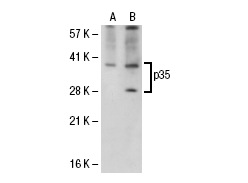
Western blot analysis of p35 expression in non-transfected: (A) and human p35 transfected: (B) 293T whole cell lysates.| Product Name | p35 Antibody (H-72) |
|---|---|
| Antibody Type | Primary Antibodies |
| Antigen Alias | epitope corresponding to amino acids 69-140 mapping near the N-terminus of p35 of human origin |
| Modification Notes | Cyclin dependent kinase-5 (Cdk5), a key regulator of cell cycle progression, was originally isolated on the basis of its structural homology to Cdc2, a well-characterized regulator of cell cycle progression. Although Cdk5 is expressed at the highest level in the brain of adult mice, intermediate levels in testis and low or undetectable levels in all other tissues, brain is the only tissue from which Cdk5 can be isolated as an active kinase. These findings may be explained by the cloning and characterization of a Cdk5 regulatory subunit, designated p35. p35 displays a neuronal cell-specific pattern of expression, physically associates with Cdk5 and activates Cdk5 enzymatic activity. p35 is also expressed in many tissues in a truncated form, designated p25. |
| Clonality | Polyclonal |
|---|---|
| Isotype | IgG |
| Host Species | Rabbit |
| Tested Applications | WBIPIFELISA |
| recommended for detection of p35 of mouse, rat and human origin by WB, IP, IF and ELISA also reactive with additional species, including equine, canine, bovine and porcine: |
|
| Species Reactivity | HumanMouseRat |
| Concentration | 1mg/ml |
| Purification | Affinity purified |
| Alternative Names | epitope corresponding to amino acids 69-140 mapping near the N-terminus of p35 of human origin |
|---|---|
| Tissue Specificity | epitope corresponding to amino acids 69-140 mapping near the N-terminus of p35 of human origin |
| Entrez Gene | 8851 |
|---|
Application
Western blot analysis of p35 expression in non-transfected: (A) and human p35 transfected: (B) 293T whole cell lysates.| Application Notes | recommended for detection of p35 of mouse, rat and human origin by WB, IP, IF and ELISA also reactive with additional species, including equine, canine, bovine and porcine: |
|---|
| Form | Liquid |
|---|---|
| Storage Instructions | For short-term storage, store at 4° C. For long-term storage, aliquot and store at -20ºC or below. Avoid multiple freeze-thaw cycles. |
| Storage Buffer | phosphate buffered saline , pH 7.4, 150mM NaCl, 0.02% sodium azide and 50% glycerol. |


