Application
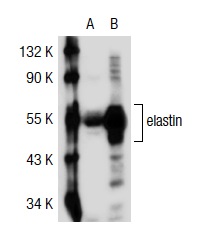
Western blot analysis of elastin expression in non-transfected: (A) and human elastin transfected: (B) 293T whole cell lysates.| Product Name | elastin Antibody (H-300) |
|---|---|
| Antibody Type | Primary Antibodies |
| Antigen Alias | epitope corresponding to amino acids 431-730 of elastin of human origin |
| Modification Notes | Elastic fibers, which are comprised primarily of elastin, endow loose connective tissue with a resilience that compliments the tensile strength of collagenous fibers. Elastin is the main component of the extracellular matrix of arteries, and it performs a regulatory function during arterial development by controlling proliferation of smooth muscle and stabilizing arterial structure. Elastin is composed largely of glycine, proline, and other hydrophobic residues, and it contains multiple lysine-derived crosslinks, such as desmosines, which link individual polypeptide chains into a rubber-like network. During aging, the elasticity of connective tissue becomes reduced because of the cross-linking of collagenous fibers with elastin. Deficiencies of elastin are associated with multiple disorders, such as supravalvular aortic stenosis and Williams-Beuren syndrome. The human elastin gene maps to chromosome 7q11.23. |
| Clonality | Polyclonal |
|---|---|
| Isotype | IgG |
| Host Species | Rabbit |
| Tested Applications | WBIPIFELISA |
| recommended for detection of elastin of human origin by WB, IP, IF and ELISA: |
|
| Species Reactivity | HumanMouseRat |
| Concentration | 1mg/ml |
| Purification | Affinity purified |
| Alternative Names | epitope corresponding to amino acids 431-730 of elastin of human origin |
|---|---|
| Tissue Specificity | epitope corresponding to amino acids 431-730 of elastin of human origin |
| Entrez Gene | 2006 |
|---|
Application
Western blot analysis of elastin expression in non-transfected: (A) and human elastin transfected: (B) 293T whole cell lysates.| Application Notes | recommended for detection of elastin of human origin by WB, IP, IF and ELISA: |
|---|
| Form | Liquid |
|---|---|
| Storage Instructions | For short-term storage, store at 4° C. For long-term storage, aliquot and store at -20ºC or below. Avoid multiple freeze-thaw cycles. |
| Storage Buffer | phosphate buffered saline , pH 7.4, 150mM NaCl, 0.02% sodium azide and 50% glycerol. |


