Application
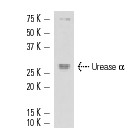
Western blot analysis of Urease α expression in a 5 µl sample of E. coli extract.| Product Name | Urease α Antibody (B-234) |
|---|---|
| Antibody Type | Primary Antibodies |
| Antigen Alias | epitope corresponding to amino acids 3-236 representing full length Urease α of H. pylori origin |
| Modification Notes | Helicobacter pylori is present in the stomachs of at least half of the world’s population (1). Although gastic adenocarcinoma is associated with the presence of H. pylori in the stomach, only a small fraction of colonized individuals develop this common malignancy (1). H. pylori urease, an enzyme that generates ammonia and is present within the lamina propria of colonized individuals, binds to class II major histocompatability complex (MHC) molecules on the surfaces of gastric epithelial cells in vitro (1,2). In addition, urease, which may be toxic to gastic epithelial cells (3), may also induce apoptosis (2). Specifically, urease plays a crucial role in the development of ulcers in the duodenum by accelerating apoptosis in the antral mucosa (4). Ammonia accelerates TNFa cytokine-induced apoptosis, while ammonia or urease alone are unable to induce apoptosis (5). Urease exists as two forms urease a (UreA) and urease b (UreB) (6,7). |
| Clonality | Polyclonal |
|---|---|
| Isotype | IgG |
| Host Species | Rabbit |
| Tested Applications | WBIPELISA |
| recommended for detection of Urease α of H. pylori, H. heilmannii, H. salmonis and, to a lesser extent, H. hepaticus, H. mustalae and H. bizzozeronii origin by WB, IP and ELISA: |
|
| Species Reactivity | HumanMouseRat |
| Concentration | 1mg/ml |
| Purification | Affinity purified |
| Alternative Names | epitope corresponding to amino acids 3-236 representing full length Urease &alpha of H. pylori origin |
|---|---|
| Tissue Specificity | epitope corresponding to amino acids 3-236 representing full length Urease α of H. pylori origin |
Application
Western blot analysis of Urease α expression in a 5 µl sample of E. coli extract.| Application Notes | recommended for detection of Urease α of H. pylori, H. heilmannii, H. salmonis and, to a lesser extent, H. hepaticus, H. mustalae and H. bizzozeronii origin by WB, IP and ELISA: |
|---|
| Form | Liquid |
|---|---|
| Storage Instructions | For short-term storage, store at 4° C. For long-term storage, aliquot and store at -20ºC or below. Avoid multiple freeze-thaw cycles. |
| Storage Buffer | phosphate buffered saline , pH 7.4, 150mM NaCl, 0.02% sodium azide and 50% glycerol. |


