Application
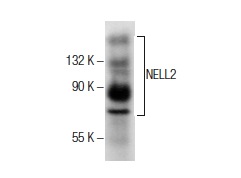
Western blot analysis of NELL2 expression in human erythocyte whole cell lysate.| Product Name | NELL2 Antibody (H-209) |
|---|---|
| Antibody Type | Primary Antibodies |
| Antigen Alias | epitope corresponding to amino acids 229-437 mapping within an internal region of NELL2 of human origin |
| Modification Notes | NELL2 (neural epidermal growth factor-like like 2), also known as NEL-related protein 2 (NRP2), is a secreted glycoprotein with one N-terminal TSP-like domain, five VWFC (von Willebrand factor C) domains and six EGF-like repeats that participate in calcium binding. NELL2 exists as a homotrimer associated with the endoplasmic reticulum (ER) and is specifically expressed in neurons playing a role in calcium-dependent intracellular events. NELL2 may act as a trophic factor in addition to its role as a signaling molecule implicated in the regulation of cell growth and differentiation. Due to alternative splicing, an additional NELL2 isoform exists that is identical to full length NELL2 except that it lacks the signal peptide that directs secretion. The additional isoform is therefore retained in the cytosol and functions as a non-secreted cytoplasmic protein that interacts with PKC bI. |
| Clonality | Polyclonal |
|---|---|
| Isotype | IgG |
| Host Species | Rabbit |
| Tested Applications | WBIPIFELISA |
| recommended for detection of NELL2 of mouse, rat and human origin by WB, IP, IF and ELISA also reactive with additional species, including equine, canine, bovine and porcine: |
|
| Species Reactivity | HumanMouseRat |
| Concentration | 1mg/ml |
| Purification | Affinity purified |
| Alternative Names | epitope corresponding to amino acids 229-437 mapping within an internal region of NELL2 of human origin |
|---|---|
| Tissue Specificity | epitope corresponding to amino acids 229-437 mapping within an internal region of NELL2 of human origin |
| Entrez Gene | 4753 |
|---|
Application
Western blot analysis of NELL2 expression in human erythocyte whole cell lysate.| Application Notes | recommended for detection of NELL2 of mouse, rat and human origin by WB, IP, IF and ELISA also reactive with additional species, including equine, canine, bovine and porcine: |
|---|
| Form | Liquid |
|---|---|
| Storage Instructions | For short-term storage, store at 4° C. For long-term storage, aliquot and store at -20ºC or below. Avoid multiple freeze-thaw cycles. |
| Storage Buffer | phosphate buffered saline , pH 7.4, 150mM NaCl, 0.02% sodium azide and 50% glycerol. |


