Application
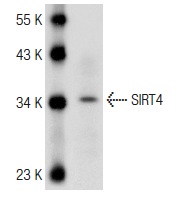
Western blot analysis of SIRT4 expression in mouse liver tissue extract.| Product Name | SIRT4 Antibody (H-234) |
|---|---|
| Antibody Type | Primary Antibodies |
| Antigen Alias | epitope corresponding to amino acids 81-314 mapping at the C-terminus of SIRT4 of human origin |
| Modification Notes | Sirtuins (SIRT1-7) are human homologs of the yeast Sir2 (silent information regulator-2) protein and are divided into four main classes: SIRT1-3 are class I, SIRT4 is class II, SIRT5 is class III and SIRT6-7 are class IV. In S. cerevisiae, Sir2 deacetylates histones in an NAD-dependent manner, which regulates silencing at the telomeric, rDNA (ribosomal DNA) and silent mating-type loci. The human SIRT proteins are NAD-dependent deacetylases that act as intracellular regulators and are thought to have ribosyltransferase activity. SIRT4 (SIR2-like protein 4), also known as SIR2L4 or sirtuin 4, belongs to the class II family of sirtuins and localizes to the mitochondrial matrix. Expressed throughout the body, SIRT4 interacts with insulin-degrading enzymes and, through its ADP-ribosyltransferase activity, functions to negatively regulate insulin secretion from pancreatic ∫ cells. SIRT4 contains one deacetylase sirtuin-type domain and can bind zinc as a catalytic cofactor. |
| Clonality | Polyclonal |
|---|---|
| Isotype | IgG |
| Host Species | Rabbit |
| Tested Applications | WBIPIFELISA |
| recommended for detection of SIRT4 of mouse, rat and human origin by WB, IP, IF and ELISA also reactive with additional species, including equine, canine, bovine and porcine: |
|
| Species Reactivity | HumanMouseRat |
| Concentration | 1mg/ml |
| Purification | Affinity purified |
| Alternative Names | epitope corresponding to amino acids 81-314 mapping at the C-terminus of SIRT4 of human origin |
|---|---|
| Tissue Specificity | epitope corresponding to amino acids 81-314 mapping at the C-terminus of SIRT4 of human origin |
| Entrez Gene | 23409 |
|---|
Application
Western blot analysis of SIRT4 expression in mouse liver tissue extract.| Application Notes | recommended for detection of SIRT4 of mouse, rat and human origin by WB, IP, IF and ELISA also reactive with additional species, including equine, canine, bovine and porcine: |
|---|
| Form | Liquid |
|---|---|
| Storage Instructions | For short-term storage, store at 4° C. For long-term storage, aliquot and store at -20ºC or below. Avoid multiple freeze-thaw cycles. |
| Storage Buffer | phosphate buffered saline , pH 7.4, 150mM NaCl, 0.02% sodium azide and 50% glycerol. |


