Application
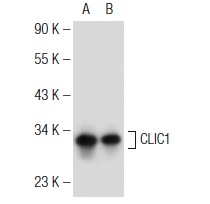
Western blot analysis of CLIC1 expression in THP-1 (A) and HL-60 (B) whole cell lysates.Application
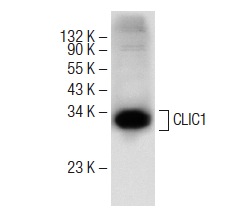
Western blot analysis of CLIC1 expression in THP-1 whole cell lysate.| Product Name | CLIC1 Antibody (H-48) |
|---|---|
| Antibody Type | Primary Antibodies |
| Antigen Alias | epitope corresponding to amino acids 194-241 mapping at the C-terminus of CLIC1 of human origin |
| Modification Notes | Chloride intracellular channel 1 (CLIC1), also referred to as NCC27, is a member of the highly conserved family of chloride ion channels that function in both soluble and integral membrane forms. CLIC1 is a monomeric protein that contains a redox-active site similar to glutaredoxin; it functions as a anion-selective channel. CLIC1 forms a dimer when oxidized and is then able to form chloride ion channels in bilayers and vesicles, whereas a reducing environment prevents this from occurring. Insulin concentration also plays a role in CLIC1 regulation, and the hormone may cause a subnuclear relocalization of CLIC1. CLIC1 is associated with macrophage activation; a downregulation of CLIC1 function prevents TNFå release induced by ∫-Amyloid protein (A-∫) stimulation. This suggests a role for CLIC1 in several neurodegenerative processes, such as Alzheimer’s disease, a syndrome characterized by an accumulation of ∫-Amyloid. |
| Clonality | Polyclonal |
|---|---|
| Isotype | IgG |
| Host Species | Rabbit |
| Tested Applications | WBIPIFELISA |
| recommended for detection of CLIC1 of mouse, rat and human origin by WB, IP, IF and ELISA may cross-react with CLIC2 also reactive with additional species, including equine, canine and bovine: |
|
| Species Reactivity | HumanMouseRat |
| Concentration | 1mg/ml |
| Purification | Affinity purified |
| Alternative Names | epitope corresponding to amino acids 194-241 mapping at the C-terminus of CLIC1 of human origin |
|---|---|
| Tissue Specificity | epitope corresponding to amino acids 194-241 mapping at the C-terminus of CLIC1 of human origin |
Application
Western blot analysis of CLIC1 expression in THP-1 (A) and HL-60 (B) whole cell lysates.
Application
Western blot analysis of CLIC1 expression in THP-1 whole cell lysate.| Application Notes | recommended for detection of CLIC1 of mouse, rat and human origin by WB, IP, IF and ELISA may cross-react with CLIC2 also reactive with additional species, including equine, canine and bovine: |
|---|
| Form | Liquid |
|---|---|
| Storage Instructions | For short-term storage, store at 4° C. For long-term storage, aliquot and store at -20ºC or below. Avoid multiple freeze-thaw cycles. |
| Storage Buffer | phosphate buffered saline , pH 7.4, 150mM NaCl, 0.02% sodium azide and 50% glycerol. |


