Application
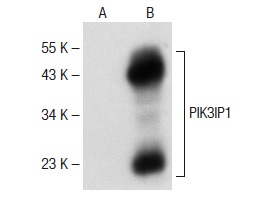
Western blot analysis of PIK3IP1 expression in non-transfected (A) and human PIK3IP1 transfected (B) CMV whole cell lysates.| Product Name | PIK3IP1 Antibody (H-180) |
|---|---|
| Antibody Type | Primary Antibodies |
| Antigen Alias | epitope corresponding to amino acids 84-263 mapping at the C-terminus of PIK3IP1 of human origin |
| Modification Notes | PIK3IP1 (phosphoinositide-3-kinase interacting protein 1), also known as HGFL, is a 263 amino acid single-pass type I membrane protein that contains one kringle domain. Expressed as three alternatively spliced isoforms, PIK3IP1 functions as a negative regulator of PI 3-kinase and is involved in the suppression of PI 3-kinase-associated hepatocellular carcinoma. The gene encoding PIK3IP1 maps to human chromosome 22, which houses over 500 genes and is the second smallest human chromosome. Mutations in several of the genes that map to chromosome 22 are involved in the development of Phelan-McDermid syndrome, Neurofibromatosis type 2, autism and schizophrenia. Additionally, translocations between chromosomes 9 and 22 may lead to the formation of the Philadelphia Chromosome and the subsequent production of the novel fusion protein BCR-Abl, a potent cell proliferation activator found in several types of leukemias. |
| Clonality | Polyclonal |
|---|---|
| Isotype | IgG |
| Host Species | Rabbit |
| Tested Applications | WBIPIFELISA |
| recommended for detection of PIK3IP1 of mouse, rat and human origin by WB, IP, IF and ELISA also reactive with additional species, including equine, canine, bovine and porcine: |
|
| Species Reactivity | HumanMouseRat |
| Concentration | 1mg/ml |
| Purification | Affinity purified |
| Alternative Names | epitope corresponding to amino acids 84-263 mapping at the C-terminus of PIK3IP1 of human origin |
|---|---|
| Tissue Specificity | epitope corresponding to amino acids 84-263 mapping at the C-terminus of PIK3IP1 of human origin |
| Entrez Gene | 113791 |
|---|
Application
Western blot analysis of PIK3IP1 expression in non-transfected (A) and human PIK3IP1 transfected (B) CMV whole cell lysates.| Application Notes | recommended for detection of PIK3IP1 of mouse, rat and human origin by WB, IP, IF and ELISA also reactive with additional species, including equine, canine, bovine and porcine: |
|---|
| Form | Liquid |
|---|---|
| Storage Instructions | For short-term storage, store at 4° C. For long-term storage, aliquot and store at -20ºC or below. Avoid multiple freeze-thaw cycles. |
| Storage Buffer | phosphate buffered saline , pH 7.4, 150mM NaCl, 0.02% sodium azide and 50% glycerol. |


