Application
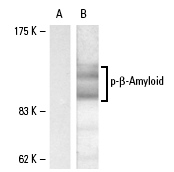
Blots were probed with p-β-Amyloid (Thr 668): preincubated with cognate phosphorylated peptide (A) and p-β-Amyloid (Thr 668): (B).| Product Name | p-β-Amyloid Antibody (Thr 668) |
|---|---|
| Antibody Type | Primary Antibodies |
| Antigen Alias | epitope corresponding to phosphorylated Thr 668 of β-Amyloid of human origin |
| Modification | Phosphoralated |
| Modification Notes | Proteolytic cleavage of the Amyloid protein precursor (APP) gives rise to the ∫-Amyloid and Amyloid A4 proteins, which are present in human platelets. Amyloid deposition is associated with type II diabetes, Down syndrome and a variety of neurological disorders, including Alzheimer’s disease. The Amyloid precursor protein (APP) undergoes alternative splicing, resulting in several isoforms. Proteolytic cleavage of APP leads to the formation of the ∫-Amyloid/Amyloid A4 protein, which plays a role in the formation of neurofibrillary tangles and plaques that characterize the senile plaques of Alzheimer’s patients. In humans, ∫-Amyloid can be phosphorylated at a variety of locations, such as Thr 668. This phosphyryloation can modulate the function of ∫-Amyloid)APLP1 (Amyloid precursor-like protein 1) and APLP2 are structurally similar to APP. Human APLP2 is a membrane- bound sperm protein that contains a region highly homologous to the transmembrane-cytoplasmic domains of APP found in brain plaques of Alzheimer’s disease patients. |
| Clonality | Polyclonal |
|---|---|
| Isotype | IgG |
| Host Species | Rabbit |
| Tested Applications | WBIP |
| recommended for detection of Thr 668 phosphorylated β-Amyloid of mouse, rat and human origin by WB and IP: |
|
| Species Reactivity | HumanMouseRat |
| Concentration | 1mg/ml |
| Purification | Affinity purified |
| Alternative Names | epitope corresponding to phosphorylated Thr 668 of &beta -Amyloid of human origin |
|---|---|
| Tissue Specificity | epitope corresponding to phosphorylated Thr 668 of β-Amyloid of human origin |
| Entrez Gene | 351 |
|---|
Application
Blots were probed with p-β-Amyloid (Thr 668): preincubated with cognate phosphorylated peptide (A) and p-β-Amyloid (Thr 668): (B).| Application Notes | recommended for detection of Thr 668 phosphorylated β-Amyloid of mouse, rat and human origin by WB and IP: |
|---|
| Form | Liquid |
|---|---|
| Storage Instructions | For short-term storage, store at 4° C. For long-term storage, aliquot and store at -20ºC or below. Avoid multiple freeze-thaw cycles. |
| Storage Buffer | phosphate buffered saline , pH 7.4, 150mM NaCl, 0.02% sodium azide and 50% glycerol. |


