Application
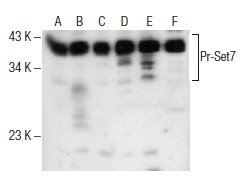
Western blot analysis of Pr-Set7 expression in NIH/3T3 (A), 3611-RF (B), MM-142 (C), RAW 264.7 (D), LADMAC (E) and WEHI-231 (F) nuclear extracts.| Product Name | Pr-Set7 Antibody (H-300) |
|---|---|
| Antibody Type | Primary Antibodies |
| Antigen Alias | epitope corresponding to amino acids 94-393 mapping at the C-terminus of Pr-Set7 of human origin |
| Modification Notes | The methylation of histones plays a pivotal role in the regulation of chromatin structure and gene expression. Histone methylation can occur on Arg or Lys residues, with an exquisite site selectivity for Lys methylation at specific positions in the N-termini of Histones H3 and H4. Pr-Set7, also referred to as SET8, is a nucleosome-specific monomethylase that specifically methylates H4 at Lys 20, a mark of constitutive and facultative heterochromatin. Pr-Set7 is a single subunit enzyme and prefers nucleosomal substrates. It functions to regulate cell-cycle-dependent transcriptional silencing and mitotic regulation in metazoans. The amino acid sequence RHRKVLRDN (17-25) is required for the SET domain of Pr-Set7 to function and, thus, for multiplicity of methylation of Lys 20 of H4 to occur. The methylation mark is very stable and is maintained even in the absence of Pr-Set7. |
| Clonality | Polyclonal |
|---|---|
| Isotype | IgG |
| Host Species | Rabbit |
| Tested Applications | WBIPIFELISA |
| recommended for detection of Pr-Set7 of mouse, rat and human origin by WB, IP, IF and ELISA also reactive with additional species, including equine, canine, bovine and porcine: |
|
| Species Reactivity | HumanMouseRat |
| Concentration | 1mg/ml |
| Purification | Affinity purified |
| Alternative Names | epitope corresponding to amino acids 94-393 mapping at the C-terminus of Pr-Set7 of human origin |
|---|---|
| Tissue Specificity | epitope corresponding to amino acids 94-393 mapping at the C-terminus of Pr-Set7 of human origin |
Application
Western blot analysis of Pr-Set7 expression in NIH/3T3 (A), 3611-RF (B), MM-142 (C), RAW 264.7 (D), LADMAC (E) and WEHI-231 (F) nuclear extracts.| Application Notes | recommended for detection of Pr-Set7 of mouse, rat and human origin by WB, IP, IF and ELISA also reactive with additional species, including equine, canine, bovine and porcine: |
|---|
| Form | Liquid |
|---|---|
| Storage Instructions | For short-term storage, store at 4° C. For long-term storage, aliquot and store at -20ºC or below. Avoid multiple freeze-thaw cycles. |
| Storage Buffer | phosphate buffered saline , pH 7.4, 150mM NaCl, 0.02% sodium azide and 50% glycerol. |


