Application
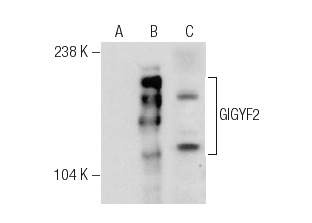
Western blot analysis of GIGYF2 expression in non-transfected: (A) and human GIGYF2 transfected: (B) 293T whole cell lysates and rat testis tissue extract (C).| Product Name | GIGYF2 Antibody (H-95) |
|---|---|
| Antibody Type | Primary Antibodies |
| Antigen Alias | epitope corresponding to amino acids 1022-1116 mapping near the C-terminus of GIGYF2 of human origin |
| Modification Notes | GIGYF2 (GRB10 interacting GYF protein 2), also known as GYF2, PERQ2, PERQ3, PARK11 or TNRC15, is a 1,299 amino acid protein that may be involved in the regulation of tyrosine kinase receptor signaling, including IGF-I and insulin receptors. Belonging to the PERQ family of proteins, GIGYF2 contains long stretches of glutamine and glutamic acid residues. Mutations in the gene encoding GIGYF2 are the cause of Parkinson disease type 11 (PARK11), which is characterized by bradykinesia, resting tremor, muscular rigidity and postural instability. Parkinson’s disease involves the loss of dopaminergic neurons in the substantia nigra and the presence of Lewy bodies (intraneuronal accumulations of aggregated proteins), in surviving neurons in various areas of the brain. PARK11 may show age-dependent or reduced penetrance. GIGYF2 exists as two alternatively spliced isoforms. |
| Clonality | Polyclonal |
|---|---|
| Isotype | IgG |
| Host Species | Rabbit |
| Tested Applications | WBIPIFELISA |
| recommended for detection of GIGYF2 of mouse, rat and human origin by WB, IP, IF and ELISA also reactive with additional species, including equine, canine and porcine: |
|
| Species Reactivity | HumanMouseRat |
| Concentration | 1mg/ml |
| Purification | Affinity purified |
| Alternative Names | epitope corresponding to amino acids 1022-1116 mapping near the C-terminus of GIGYF2 of human origin |
|---|---|
| Tissue Specificity | epitope corresponding to amino acids 1022-1116 mapping near the C-terminus of GIGYF2 of human origin |
| Entrez Gene | 26058 |
|---|
Application
Western blot analysis of GIGYF2 expression in non-transfected: (A) and human GIGYF2 transfected: (B) 293T whole cell lysates and rat testis tissue extract (C).| Application Notes | recommended for detection of GIGYF2 of mouse, rat and human origin by WB, IP, IF and ELISA also reactive with additional species, including equine, canine and porcine: |
|---|
| Form | Liquid |
|---|---|
| Storage Instructions | For short-term storage, store at 4° C. For long-term storage, aliquot and store at -20ºC or below. Avoid multiple freeze-thaw cycles. |
| Storage Buffer | phosphate buffered saline , pH 7.4, 150mM NaCl, 0.02% sodium azide and 50% glycerol. |


