Application
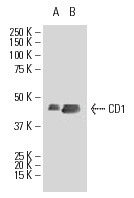
Western blot analysis of CD1 expression in mouse liver (A) and rat liver (B) tissue extracts.| Product Name | CD1 Antibody (M-276) |
|---|---|
| Antibody Type | Primary Antibodies |
| Antigen Alias | epitope corresponding to amino acids 22-297 of CD1 of mouse origin |
| Modification Notes | The CD1 multigene family encodes five forms of the CD1 T-cell surface glycoprotein in human, designated CD1A, 1B, 1C, 1D and 1E. CD1, a type 1 membrane protein, has structural similarity to the MHC class I antigen and has been shown to present lipid antigens for recognition by T lymphocytes. CD1 antigens are associated with ∫-2-Microglobulin and expressed on cortical thymocytes, Langerhans cells, a B cell subset and some dendritic cells. Specifically, CD1A is a marker for Langerhans cell histiocytosis (LCH) and is found on interdigitating cells. Adaptor-protein complexes and CD1-associated chaperones control CD1 trafficking, and the development and activation of CD1-restricted T cells. Constitutive endocytosis of CD1B molecules and the differential sorting of MHC class II from lysosomes separate peptide- and lipid antigen-presenting molecules during dendritic cell maturation. CD1B is also expressed in interdigitating cells. The human CD1 genes are all closely linked in a cluster mapping at chromosome 1q 22-23. |
| Clonality | Polyclonal |
|---|---|
| Isotype | IgG |
| Host Species | Rabbit |
| Tested Applications | WBIPIFELISA |
| recommended for detection of all CD1 isoforms of mouse and rat origin by WB, IP, IF and ELISA: |
|
| Species Reactivity | HumanMouseRat |
| Concentration | 1mg/ml |
| Purification | Affinity purified |
| Alternative Names | epitope corresponding to amino acids 22-297 of CD1 of mouse origin |
|---|---|
| Tissue Specificity | epitope corresponding to amino acids 22-297 of CD1 of mouse origin |
Application
Western blot analysis of CD1 expression in mouse liver (A) and rat liver (B) tissue extracts.| Application Notes | recommended for detection of all CD1 isoforms of mouse and rat origin by WB, IP, IF and ELISA: |
|---|
| Form | Liquid |
|---|---|
| Storage Instructions | For short-term storage, store at 4° C. For long-term storage, aliquot and store at -20ºC or below. Avoid multiple freeze-thaw cycles. |
| Storage Buffer | phosphate buffered saline , pH 7.4, 150mM NaCl, 0.02% sodium azide and 50% glycerol. |


