Application
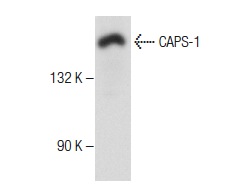
Western blot analysis of CAPS-1 expression in rat brain tissue extract.| Product Name | CAPS-1 Antibody (H-60) |
|---|---|
| Antibody Type | Primary Antibodies |
| Antigen Alias | epitope corresponding to amino acids 1001-1060 mapping within an internal region of CAPS-1 of human origin |
| Modification Notes | Calcium-dependent secretion activators (CAPS-1 and CAPS-2) are calcium-binding proteins that direct neurotransmitter and neuropeptide-filled vesicles to the cell membrane for secretory granule exocytosis. Both CAPS-1 and CAPS-2 are expressed primarily in the brain where they regulate the secretion of various substances. The CAPS proteins contain a PH domain that is essential for regulation of exocytosis, as well as regulation of phospholipid binding. Through their regulation of neurotrophin release from granule cells, CAPS proteins help to regulate cell fate during neuronal development. CAPS-1 is thought to regulate catecholamine release from neuronal cells, while CAPS-2 is thought to regulate release of both brain-derived neurotrophic factor (BDNF) and neurotrophin-3 (NT-3) from granule cells. Defects in the genes encoding CAPS-1 and CAPS-2 are implicated in impaired cerebral development and autism. |
| Clonality | Polyclonal |
|---|---|
| Isotype | IgG |
| Host Species | Rabbit |
| Tested Applications | WBIPIFELISA |
| recommended for detection of CAPS-1 of mouse, rat and human origin by WB, IP, IF and ELISA also reactive with additional species, including equine, canine, bovine, porcine and avian: |
|
| Species Reactivity | HumanMouseRat |
| Concentration | 1mg/ml |
| Purification | Affinity purified |
| Alternative Names | epitope corresponding to amino acids 1001-1060 mapping within an internal region of CAPS-1 of human origin |
|---|---|
| Tissue Specificity | epitope corresponding to amino acids 1001-1060 mapping within an internal region of CAPS-1 of human origin |
| Entrez Gene | 8618 |
|---|
Application
Western blot analysis of CAPS-1 expression in rat brain tissue extract.| Application Notes | recommended for detection of CAPS-1 of mouse, rat and human origin by WB, IP, IF and ELISA also reactive with additional species, including equine, canine, bovine, porcine and avian: |
|---|
| Form | Liquid |
|---|---|
| Storage Instructions | For short-term storage, store at 4° C. For long-term storage, aliquot and store at -20ºC or below. Avoid multiple freeze-thaw cycles. |
| Storage Buffer | phosphate buffered saline , pH 7.4, 150mM NaCl, 0.02% sodium azide and 50% glycerol. |


