Application
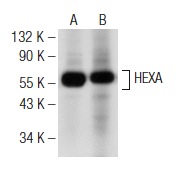
Western blot analysis of HEXA expression in rat liver (A) and mouse liver (B) tissue extracts.| Product Name | HEXA Antibody (H-40) |
|---|---|
| Antibody Type | Primary Antibodies |
| Antigen Alias | epitope corresponding to amino acids 377-416 mapping within an internal region of HEXA of human origin |
| Modification Notes | Hexosaminidase A (HEXA), also designated beta-Hexosaminidase A, is a trimer composed of one å chain, one ∫-A chain and one ∫-B chain and is found in the lysosomes of cells. HEXA, along with the cofactor CM2 activator protein, catalyzes the degradation of GM2 ganglioside and other molecules containing terminal N-acetyl hexosamines in the brain and other tissues. A mutation in the å subunit of hexosaminidase is the cause of Tay-Sachs disease (TSD), also known as GM2-gangliosidosis type I. TSD is a fatal autosomal recessive lysosomal storage disease of the central nervous system (CNS) caused by insufficient activity of the HEXA enzyme that results in a failure to process GM2 gangliosides. The accumulation of GM2 ganglioside in the absence of HEXA activity causes progressive destruction of the CNS. |
| Clonality | Polyclonal |
|---|---|
| Isotype | IgG |
| Host Species | Rabbit |
| Tested Applications | WBIPIFELISA |
| recommended for detection of HEXA of human origin by WB, IP, IF and ELISA: |
|
| Species Reactivity | HumanMouseRat |
| Concentration | 1mg/ml |
| Purification | Affinity purified |
| Alternative Names | epitope corresponding to amino acids 377-416 mapping within an internal region of HEXA of human origin |
|---|---|
| Tissue Specificity | epitope corresponding to amino acids 377-416 mapping within an internal region of HEXA of human origin |
Application
Western blot analysis of HEXA expression in rat liver (A) and mouse liver (B) tissue extracts.| Application Notes | recommended for detection of HEXA of human origin by WB, IP, IF and ELISA: |
|---|
| Form | Liquid |
|---|---|
| Storage Instructions | For short-term storage, store at 4° C. For long-term storage, aliquot and store at -20ºC or below. Avoid multiple freeze-thaw cycles. |
| Storage Buffer | phosphate buffered saline , pH 7.4, 150mM NaCl, 0.02% sodium azide and 50% glycerol. |


