Application
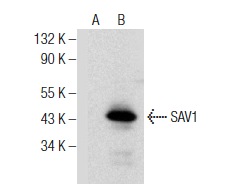
Western blot analysis of SAV1 expression in non-transfected: (A) and mouse SAV1 transfected: (B) 293T whole cell lysates.| Product Name | SAV1 Antibody (H-200) |
|---|---|
| Antibody Type | Primary Antibodies |
| Antigen Alias | epitope corresponding to amino acids 1-200 mapping at the N-terminus of SAV1 of human origin |
| Modification Notes | SAV1 (Salvador homolog 1), also known as SAV, WW45 (45 kDa WW domain protein) or WWP4, is a ubiquitously expressed protein with one SARAH (Salvador/Rassf/Hippo) domain and two WW domains. The SARAH domain is a protein-protein interaction domain that is involved in cell cycle regulation and apoptosis. SAV1 can form homodimers and is believed to function as a scaffold protein of the Hippo pathway. Via its SARAH domain, SAV1 is capable of binding Krs-2, a protein that restricts cell proliferation and promotes apoptosis. This interaction is important for the transduction of apoptosis and cell cycle arrest signals. More specifically, SAV1 is essential for the nuclear translocation and activation of Krs-2. Both of these events (Krs-2 translocation and activation) are required for the subsequent phosphorylation of LATS1 and kpm, two major tumor suppressors. Defects in this pathway (the Hippo pathway) have been associated with tumorigenesis, suggesting that dysfunctional SAV1 may contribute to tumor development. |
| Clonality | Polyclonal |
|---|---|
| Isotype | IgG |
| Host Species | Rabbit |
| Tested Applications | WBIPIFELISA |
| recommended for detection of SAV1 of mouse, rat and human origin by WB, IP, IF and ELISA also reactive with additional species, including canine, bovine and porcine: |
|
| Species Reactivity | HumanMouseRat |
| Concentration | 1mg/ml |
| Purification | Affinity purified |
| Alternative Names | epitope corresponding to amino acids 1-200 mapping at the N-terminus of SAV1 of human origin |
|---|---|
| Tissue Specificity | epitope corresponding to amino acids 1-200 mapping at the N-terminus of SAV1 of human origin |
| Entrez Gene | 60485 |
|---|
Application
Western blot analysis of SAV1 expression in non-transfected: (A) and mouse SAV1 transfected: (B) 293T whole cell lysates.| Application Notes | recommended for detection of SAV1 of mouse, rat and human origin by WB, IP, IF and ELISA also reactive with additional species, including canine, bovine and porcine: |
|---|
| Form | Liquid |
|---|---|
| Storage Instructions | For short-term storage, store at 4° C. For long-term storage, aliquot and store at -20ºC or below. Avoid multiple freeze-thaw cycles. |
| Storage Buffer | phosphate buffered saline , pH 7.4, 150mM NaCl, 0.02% sodium azide and 50% glycerol. |


