Application
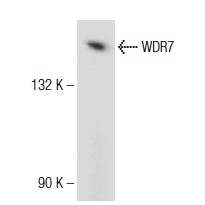
Western blot analysis of WDR7 expression in rat brain tissue extract.| Product Name | WDR7 Antibody (N-20) |
|---|---|
| Antibody Type | Primary Antibodies |
| Antigen Alias | epitope mapping near the N-terminus of WDR7 of human origin |
| Modification Notes | WD-repeats are motifs that are found in a variety of proteins and are characterized by a conserved core of 40-60 amino acids, which commonly form a tertiary propeller structure. While proteins that contain WD-repeats participate in a wide range of cellular functions, they are generally involved in regulatory mechanisms involving signal transduction, apoptosis, transcriptional regulation, cell cycle control. WD repeats serve as sites for protein-protein interaction and some seem to mediate the assembly of protein complexes. With 9 WD repeats, WDR7 (WD repeat-containing protein 7), also known as TGF-beta resistance-associated protein (TRAG) and Rabconnectin-3 beta, is a 1490 amino acid protein that is abundantly expressed in brain and colocalizes with rabconnectin-3 on synaptic vesicles. Unlike rabconnectin-3, WDR7 binds directly to Rab3 GDP/GTP exchange protein and may therefore play a role in cell proliferation and survival. There are two isoforms of WDR7 that are produced as a result of alternative splicing events. |
| Clonality | Polyclonal |
|---|---|
| Isotype | IgG |
| Host Species | Rabbit |
| Tested Applications | WBIPIFELISA |
| recommended for detection of WDR7 of mouse, rat and human origin by WB, IP, IF and ELISA non cross-reactive with WDR4 and WDR5 also reactive with additional species, including equine, canine, bovine, porcine and avian: |
|
| Species Reactivity | HumanMouseRat |
| Concentration | 1mg/ml |
| Purification | Affinity purified |
| Alternative Names | epitope mapping near the N-terminus of WDR7 of human origin |
|---|---|
| Tissue Specificity | epitope mapping near the N-terminus of WDR7 of human origin |
| Entrez Gene | 23335 |
|---|
Application
Western blot analysis of WDR7 expression in rat brain tissue extract.| Application Notes | recommended for detection of WDR7 of mouse, rat and human origin by WB, IP, IF and ELISA non cross-reactive with WDR4 and WDR5 also reactive with additional species, including equine, canine, bovine, porcine and avian: |
|---|
| Form | Liquid |
|---|---|
| Storage Instructions | For short-term storage, store at 4° C. For long-term storage, aliquot and store at -20ºC or below. Avoid multiple freeze-thaw cycles. |
| Storage Buffer | phosphate buffered saline , pH 7.4, 150mM NaCl, 0.02% sodium azide and 50% glycerol. |


