Application
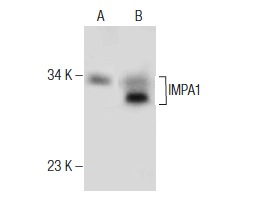
Western blot analysis of IMPA1 expression in PC-3 (A) and IMR-32 (B) whole cell lysates.| Product Name | IMPA1 Antibody (H-85) |
|---|---|
| Antibody Type | Primary Antibodies |
| Antigen Alias | epitope corresponding to amino acids 1-85 mapping at the N-terminus of IMPA1 of human origin |
| Modification Notes | IMPA1, also known as Myo-inositol monophosphatase 1, is responsible for the procurement of inositol that is required for synthesis of phosphatidylinositol and polyphosphoinositides. IMPA1 exists as a homodimer and has been identified as the pharmacological target for lithium action in the brain. IMPA1 is the principal enzyme of the phosphatidyl inositol signaling pathway, and inhibition of inositol monophosphatase hydrolysis may underlie the anti-manic and anti-depressant actions of Li+. Studies indicate that a variation in the 277 codon coding region of the IMPA1 gene has not been observed in manic-depressive patients, therefore suggesting that polymorphisms or mutations in the noncoding regions of this gene may influence the lithium response in psychiatric patients. |
| Clonality | Polyclonal |
|---|---|
| Isotype | IgG |
| Host Species | Rabbit |
| Tested Applications | WBIPIFELISA |
| recommended for detection of Myo-inositol monophosphatase 1 of mouse, rat and human origin by WB, IP, IF and ELISA also reactive with additional species, including equine, canine, bovine and porcine: |
|
| Species Reactivity | HumanMouseRat |
| Concentration | 1mg/ml |
| Purification | Affinity purified |
| Alternative Names | epitope corresponding to amino acids 1-85 mapping at the N-terminus of IMPA1 of human origin |
|---|---|
| Tissue Specificity | epitope corresponding to amino acids 1-85 mapping at the N-terminus of IMPA1 of human origin |
Application
Western blot analysis of IMPA1 expression in PC-3 (A) and IMR-32 (B) whole cell lysates.| Application Notes | recommended for detection of Myo-inositol monophosphatase 1 of mouse, rat and human origin by WB, IP, IF and ELISA also reactive with additional species, including equine, canine, bovine and porcine: |
|---|
| Form | Liquid |
|---|---|
| Storage Instructions | For short-term storage, store at 4° C. For long-term storage, aliquot and store at -20ºC or below. Avoid multiple freeze-thaw cycles. |
| Storage Buffer | phosphate buffered saline , pH 7.4, 150mM NaCl, 0.02% sodium azide and 50% glycerol. |


