Application
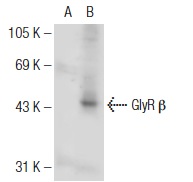
Western blot analysis of GlyR β expression in non-transfected: (A) and mouse GlyR β transfected: (B) 293T whole cell lysates.| Product Name | GlyR β Antibody (H-170) |
|---|---|
| Antibody Type | Primary Antibodies |
| Antigen Alias | epitope corresponding to amino acids 328-497 mapping at the C-terminus of GlyR β of human origin |
| Modification Notes | In the central nervous system (CNS), glycine-mediated inhibitory neurotransmission is essential to voluntary motor control and reflex responses. Glycine binds to glycine receptors (GlyR) in the postsynaptic neuronal membranes. GlyR, ?-aminobutryic acid, serotonin and acetylcholine comprise an evolutionally conserved superfamily of ligand-gated ion channels. The pentameric subunit structure of GlyR consists of two types of glycosylated membrane proteins, ?1 through ?4 and ?, and an associated peripheral membrane protein, which combine to form a chloride-selective ion channel. In humans, the composition of the pentamer changes from ?2 subunits in the fetal CNS to ?1 and ? subunits in the adult CNS. Fast potentiation of GlyR by intracellular Ca2+ in the brainstem and midbrain indicate an important role for Ca2+ in modulation of glycinergic synapses. The genes encoding human GlyR ?1, ?2, ?3 and ? subunits map to chromosomes 5q32, Xp22, 4q33 and 4q31, respectively. |
| Clonality | Polyclonal |
|---|---|
| Isotype | IgG |
| Host Species | Rabbit |
| Tested Applications | WBIPIFELISA |
| recommended for detection of GlyR β of mouse, rat and human origin by WB, IP, IF and ELISA also reactive with additional species, including equine, canine, bovine, porcine and avian: |
|
| Species Reactivity | HumanMouseRat |
| Concentration | 1mg/ml |
| Purification | Affinity purified |
| Alternative Names | epitope corresponding to amino acids 328-497 mapping at the C-terminus of GlyR &beta of human origin |
|---|---|
| Tissue Specificity | epitope corresponding to amino acids 328-497 mapping at the C-terminus of GlyR β of human origin |
| Entrez Gene | 2743 |
|---|
Application
Western blot analysis of GlyR β expression in non-transfected: (A) and mouse GlyR β transfected: (B) 293T whole cell lysates.| Application Notes | recommended for detection of GlyR β of mouse, rat and human origin by WB, IP, IF and ELISA also reactive with additional species, including equine, canine, bovine, porcine and avian: |
|---|
| Form | Liquid |
|---|---|
| Storage Instructions | For short-term storage, store at 4° C. For long-term storage, aliquot and store at -20ºC or below. Avoid multiple freeze-thaw cycles. |
| Storage Buffer | phosphate buffered saline , pH 7.4, 150mM NaCl, 0.02% sodium azide and 50% glycerol. |


