Application
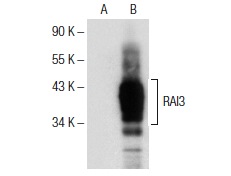
Western blot analysis of RAI3 expression in non-transfected (A) and human RAI3 transfected (B) whole cell lysates.| Product Name | RAI3 Antibody (M-120) |
|---|---|
| Antibody Type | Primary Antibodies |
| Antigen Alias | epitope corresponding to amino acids 237-356 mapping at the C-terminus of RAI3 of mouse origin |
| Modification Notes | Retinoic acid-induced protein 3 (RAI3) is an transmembrane G-protein-coupled receptor that affects many essential biological processes including embryogenesis, cell growth, differentiation, and apoptosis. RAI3 may also be involved in maintaining homeostasis of epithelial cells. Retinoic acid receptors directly regulate RAI3 during its transcription in embryonal carcinoma differentiation. RAI3 expression is upregulated in most tumor cell lines that express mutant p53, suggesting that p53 interacts with the promoter of RAI3 and represses its expression at the beginning of apoptosis. RAI3 is a potential molecular target for diagnosing breast cancer, and selective suppression of signals from RAI3 may have a place in breast cancer treatments. |
| Clonality | Polyclonal |
|---|---|
| Isotype | IgG |
| Host Species | Rabbit |
| Tested Applications | WBIPIFELISA |
| recommended for detection of RAI3 of mouse, rat and, to a lesser extent, human origin by WB, IP, IF and ELISA: |
|
| Species Reactivity | HumanMouseRat |
| Concentration | 1mg/ml |
| Purification | Affinity purified |
| Alternative Names | epitope corresponding to amino acids 237-356 mapping at the C-terminus of RAI3 of mouse origin |
|---|---|
| Tissue Specificity | epitope corresponding to amino acids 237-356 mapping at the C-terminus of RAI3 of mouse origin |
Application
Western blot analysis of RAI3 expression in non-transfected (A) and human RAI3 transfected (B) whole cell lysates.| Application Notes | recommended for detection of RAI3 of mouse, rat and, to a lesser extent, human origin by WB, IP, IF and ELISA: |
|---|
| Form | Liquid |
|---|---|
| Storage Instructions | For short-term storage, store at 4° C. For long-term storage, aliquot and store at -20ºC or below. Avoid multiple freeze-thaw cycles. |
| Storage Buffer | phosphate buffered saline , pH 7.4, 150mM NaCl, 0.02% sodium azide and 50% glycerol. |


