Application
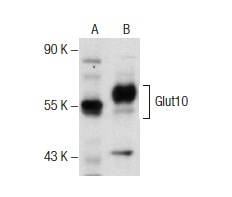
Western blot analysis of Glut10 expression in Hep G2 (A) and c4 (B) whole cell lysates.| Product Name | Glut10 Antibody (H-96) |
|---|---|
| Antibody Type | Primary Antibodies |
| Antigen Alias | epitope corresponding to amino acids 321-416 mapping within an extracellular domain of Glut10 of human origin |
| Modification Notes | Glucose serves as the major energy substrate of mammalian cells and is fundamental to metabolism. Glucose passage across cell membranes is mediated by a family of transporters termed glucose transporters, or Gluts, which are characterized by the presence of 12 membrane-spanning helices. The Glut family is divided into three subfamilies: class I (previously known as glucose transporters), which includes Glut1, Glut2, Glut3 and Glut4; class II (previously known as fructose transporters), which includes Glut5, Glut7, Glut9 and Glut11; and class III, which includes Glut6, Glut8, Glut10, Glut12 and the myo-inositol transporter HMIT1. Glut10 is a 541 amino acid facilitative glucose transporter expressed in high amounts in liver and pancreas. It contains 12 transmembrane domains, with a hydrophilic intracellular loop between helices 6 and 7, and a potential N-linked glycosylation site, with a large extracellular loop between helices 9 and 10. The gene for Glut 10, SLC2A10, maps to chromosome 20q13.1, a region that is linked to type 2 diabetes. |
| Clonality | Polyclonal |
|---|---|
| Isotype | IgG |
| Host Species | Rabbit |
| Tested Applications | WBIPIFELISA |
| recommended for detection of Glut10 of human origin by WB, IP, IF and ELISA: |
|
| Species Reactivity | HumanMouseRat |
| Concentration | 1mg/ml |
| Purification | Affinity purified |
| Alternative Names | epitope corresponding to amino acids 321-416 mapping within an extracellular domain of Glut10 of human origin |
|---|---|
| Tissue Specificity | epitope corresponding to amino acids 321-416 mapping within an extracellular domain of Glut10 of human origin |
| Entrez Gene | 81031 |
|---|
Application
Western blot analysis of Glut10 expression in Hep G2 (A) and c4 (B) whole cell lysates.| Application Notes | recommended for detection of Glut10 of human origin by WB, IP, IF and ELISA: |
|---|
| Form | Liquid |
|---|---|
| Storage Instructions | For short-term storage, store at 4° C. For long-term storage, aliquot and store at -20ºC or below. Avoid multiple freeze-thaw cycles. |
| Storage Buffer | phosphate buffered saline , pH 7.4, 150mM NaCl, 0.02% sodium azide and 50% glycerol. |


