Application
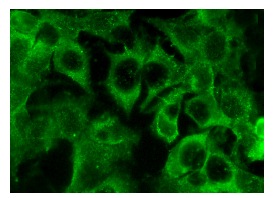
Immunofluorescence staining of formalin-fixed Hep G2 cells showing cytoplasmic localization.Application
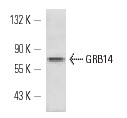
Western blot analysis of GRB14 expression in Hep G2 whole cell lysate.| Product Name | GRB14 Antibody (H-80) |
|---|---|
| Antibody Type | Primary Antibodies |
| Antigen Alias | epitope corresponding to amino acids 1-80 of GRB14 of human origin |
| Modification Notes | Many growth factors function by binding receptors with intrinsic tyrosine kinase activity. Signaling by such receptors involves a series of intermediates characterized by SH2 domains that bind tyrosine phosphorylated receptors by a direct interaction between the SH2 domain and specific phospho-tyrosine-containing receptor sequences. GRB7, a SH2 domain protein, has a single SH2 domain at its C-terminal, a central region with similarity to Ras GAP and a proline-rich N-terminus. A related SH2 domain-containing protein, GRB10, exhibits a high degree of homology with GRB7. GRB10 undergoes serine but not tyrosine phosphorylation in response to EGF treatment, but appears to bind to the EGF receptor poorly. An additional member of the GRB7 family, designated GRB14, contains a Pleckstrin homology domain in its central region and a carboxy-terminal SH2 domain. GRB14 mRNA is expressed at high levels in a broad range of tissues including liver, kidney, pancreas, testis, ovary, heart and skeletal muscle. Expression of the GRB14 protein in breast carcinomas is strongly correlated with estrogen receptor positivity. |
| Clonality | Polyclonal |
|---|---|
| Isotype | IgG |
| Host Species | Rabbit |
| Tested Applications | WBIPIFELISA |
| recommended for detection of GRB14 of human origin by WB, IP, IF and ELISA also reactive with additional species, including bovine: |
|
| Species Reactivity | HumanMouseRat |
| Concentration | 1mg/ml |
| Purification | Affinity purified |
| Alternative Names | epitope corresponding to amino acids 1-80 of GRB14 of human origin |
|---|---|
| Tissue Specificity | epitope corresponding to amino acids 1-80 of GRB14 of human origin |
| Entrez Gene | 2888 |
|---|
Application
Immunofluorescence staining of formalin-fixed Hep G2 cells showing cytoplasmic localization.
Application
Western blot analysis of GRB14 expression in Hep G2 whole cell lysate.| Application Notes | recommended for detection of GRB14 of human origin by WB, IP, IF and ELISA also reactive with additional species, including bovine: |
|---|
| Form | Liquid |
|---|---|
| Storage Instructions | For short-term storage, store at 4° C. For long-term storage, aliquot and store at -20ºC or below. Avoid multiple freeze-thaw cycles. |
| Storage Buffer | phosphate buffered saline , pH 7.4, 150mM NaCl, 0.02% sodium azide and 50% glycerol. |


