Application
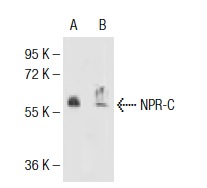
Western blot analysis of NPR-C expression in NCI-H460 (A) and HL-60 (B) whole cell lysates.| Product Name | NPR-C Antibody (L-23) |
|---|---|
| Antibody Type | Primary Antibodies |
| Antigen Alias | recommended for detection of NPR-C of human origin by WB, IF, IHC(P) and ELISA |
| Modification Notes | The natriuretic peptides are a group of structurally similar peptides that are genetically distinct and play a role in several processes, including cardiovascular, renal and endocrine homeostasis. The atrial natriuretic peptide (ANP) and brain natriuretic peptide (BNP) are derived from myocardial cell origin and are cardiac hormones secreted from the atrium and ventricle of the heart, respectively. The C-type natriuretic peptide (CNP) is derived from endothelial cell origin and acts as an endothelium-derived relaxing factor (EDRF). These peptides mediate their effects through three receptors. NPR-A (also designated GC-A) binds both ANP and BNP, which stimulates 3’, 5’-cyclic guanosine monophosphate (cGMP) to mediate natriuresis, vasodilation, renin inhibition, antimitogenesis and lusitropic properties. NPR-B (also designated GC-B) binds CNP and also stimulates cGMP to facilitate vasodilation and growth inhibition. NPR-C, also designated the ‘clearance’ receptor, clears all three peptides, which are subsequently degraded by the ectoenzyme neutral endopeptidase. The natriuretic peptide system plays an important role in hypertension, congestive heart failure, atherosclerosis and renal diseases, and may be a therapeutic target in the treatment of these diseases. |
| Clonality | Polyclonal |
|---|---|
| Isotype | IgG |
| Host Species | Rabbit |
| Tested Applications | WBIFIHCELISA |
| WB:1:500~1:2000 IF:1:200~1:500 IHC:1:50~1:200 Notes:Optimal dilutions/concentrations should be determined by the researcher. |
|
| Species Reactivity | HumanMouseRat |
| Concentration | 1mg/ml |
| Purification | Affinity purified |
| Alternative Names | recommended for detection of NPR-C of human origin by WB IF IHC(P) and ELISA |
|---|---|
| Tissue Specificity | recommended for detection of NPR-C of human origin by WB, IF, IHC(P) and ELISA |
| Entrez Gene | 4883 |
|---|
Application
Western blot analysis of NPR-C expression in NCI-H460 (A) and HL-60 (B) whole cell lysates.| Application Notes | WB:1:500~1:2000 IF:1:200~1:500 IHC:1:50~1:200 Notes:Optimal dilutions/concentrations should be determined by the researcher. |
|---|
| Form | Liquid |
|---|---|
| Storage Instructions | For short-term storage, store at 4° C. For long-term storage, aliquot and store at -20ºC or below. Avoid multiple freeze-thaw cycles. |
| Storage Buffer | phosphate buffered saline , pH 7.4, 150mM NaCl, 0.02% sodium azide and 50% glycerol. |


