Application
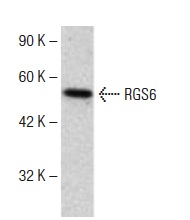
Western blot analysis of RGS6 expression in Jurkat whole cell lysate.Application
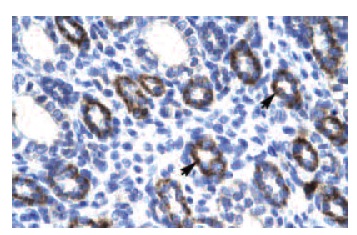
Immunoperoxidase staining of formalin-fixed, paraffin-embedded human kidney tissue showing cytoplasmic localization.| Product Name | RGS6 Antibody (U-23) |
|---|---|
| Antibody Type | Primary Antibodies |
| Antigen Alias | recommended for detection of RGS6 of mouse, rat and human origin by WB, IP, IF, IHC(P) and ELISA; also reactive with additional species, including canine |
| Modification Notes | Heterotrimeric G proteins function to relay information from cell surface receptors to various intracellular effectors. G proteins comprise å, ß and g subunits, and following activation the å subunit binds GTP and dissociates from the ßg complex. A large group of proteins have been identified as GTPase-activating proteins (GAPs), including the RGS (regulator of G protein signaling) family, which serve to deactivate specific Gå isoforms by increasing the rate at which they convert GTP to GDP. A subfamily of RGS proteins expressed in the central nervous system contain, in addition to the highly conserved RGS domain, a characteristic GGL domain, or G protein g subunit-like domain, which mediates binding to Gß 5 subunits. This subfamily, which includes RGS6, RGS7, RGS9 and RGS11, associates with Gß 5 to form active GAP complexes that are predominantly localized to the cytosol. RGS/ß5 complexes preferentially target Gåo subunit for hydrolysis and inhibit Gß1g2-mediated activation of phospholipase C. |
| Clonality | Polyclonal |
|---|---|
| Isotype | IgG |
| Host Species | Rabbit |
| Tested Applications | WBIPIFIHCELISA |
| WB:1:500~1:2000 IP:1:100~1:500 IF:1:200~1:500 IHC:1:50~1:200 Notes:Optimal dilutions/concentrations should be determined by the researcher. |
|
| Species Reactivity | HumanMouseRat |
| Concentration | 1mg/ml |
| Purification | Affinity purified |
| Alternative Names | recommended for detection of RGS6 of mouse rat and human origin by WB IP IF IHC(P) and ELISA also reactive with additional species including canine |
|---|---|
| Tissue Specificity | recommended for detection of RGS6 of mouse, rat and human origin by WB, IP, IF, IHC(P) and ELISA; also reactive with additional species, including canine |
| Entrez Gene | 9628 |
|---|
Application
Western blot analysis of RGS6 expression in Jurkat whole cell lysate.
Application
Immunoperoxidase staining of formalin-fixed, paraffin-embedded human kidney tissue showing cytoplasmic localization.| Application Notes | WB:1:500~1:2000 IP:1:100~1:500 IF:1:200~1:500 IHC:1:50~1:200 Notes:Optimal dilutions/concentrations should be determined by the researcher. |
|---|
| Form | Liquid |
|---|---|
| Storage Instructions | For short-term storage, store at 4° C. For long-term storage, aliquot and store at -20ºC or below. Avoid multiple freeze-thaw cycles. |
| Storage Buffer | phosphate buffered saline , pH 7.4, 150mM NaCl, 0.02% sodium azide and 50% glycerol. |


