Application
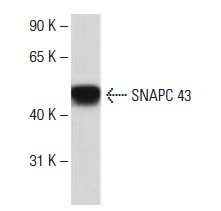
Western blot analysis of human SNAPC 43 transfected 293T whole cell lysate.| Product Name | SNAPC 43 Antibody (H-22) |
|---|---|
| Antibody Type | Primary Antibodies |
| Antigen Alias | recommended for detection of SNAPC 43 of human origin by WB, IP, IF, IHC(P) and ELISA |
| Modification Notes | TATA-box binding protein (TBP) interactions with TBP-associated factors (TAFs) are required for the transcription of RNA polymerases. One particular TBP-TAF complex, snRNA-activating protein complex (SNAPC), is unusual in that it regulates basal transcription of both RNA polymerase II and III by binding specifically to a non-TATA-box proximal sequence element (PSE). SNAPC consists of five subunits of varying size. SNAPC binds to Oct-1 and TBP, which are activators of snRNA and RNA polymerases, respectively. The POU domain of Oct-1 binds to SNAPC 190 and effectively recruits SNAPC to the PSE. The cooperative binding of SNAPC and Oct-1 to their respective sequence elements is mediated by a nucleosome positioned between the two sequence elements. SNAPC 19 mediates the assembly of the subunits to form a functional SNAPC transcription regulator. SNAPC 50 (also designated PTFb) contains two zinc finger motifs and binds to SNAPC 43 (also designated PTFg) but not SNAPC 45 (PTFd). |
| Clonality | Polyclonal |
|---|---|
| Isotype | IgG |
| Host Species | Rabbit |
| Tested Applications | WBIPIFIHCELISA |
| WB:1:500~1:2000 IP:1:100~1:500 IF:1:200~1:500 IHC:1:50~1:200 Notes:Optimal dilutions/concentrations should be determined by the researcher. |
|
| Species Reactivity | HumanMouseRat |
| Concentration | 1mg/ml |
| Purification | Affinity purified |
| Alternative Names | recommended for detection of SNAPC 43 of human origin by WB IP IF IHC(P) and ELISA |
|---|---|
| Tissue Specificity | recommended for detection of SNAPC 43 of human origin by WB, IP, IF, IHC(P) and ELISA |
| Entrez Gene | 6617 |
|---|
Application
Western blot analysis of human SNAPC 43 transfected 293T whole cell lysate.| Application Notes | WB:1:500~1:2000 IP:1:100~1:500 IF:1:200~1:500 IHC:1:50~1:200 Notes:Optimal dilutions/concentrations should be determined by the researcher. |
|---|
| Form | Liquid |
|---|---|
| Storage Instructions | For short-term storage, store at 4° C. For long-term storage, aliquot and store at -20ºC or below. Avoid multiple freeze-thaw cycles. |
| Storage Buffer | phosphate buffered saline , pH 7.4, 150mM NaCl, 0.02% sodium azide and 50% glycerol. |


