Application
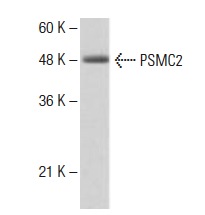
Western blot analysis of PSMC2 expression in Jurkat whole cell lysate.| Product Name | PSMC2 Antibody (O-22) |
|---|---|
| Antibody Type | Primary Antibodies |
| Antigen Alias | recommended for detection of PSMC2 of mouse, rat and human origin by WB, IP and ELISA; also reactive with additional species, including canine |
| Modification Notes | In eukaryotic cells, selective breakdown of cellular proteins is ensured by their ubiquitination and subsequent degradation by the 26S Proteasome. The 26S Proteasome is a protease complex that selectively breaks down proteins that have been modified by polyubiquitin chains. It is made up of two multisubunit complexes: the 20S Proteasome chamber, which serves as the proteolytic core of the complex, and two 19S regulatory particles, which recognize and unfold ubiquitinated proteins. PSMC2 (Proteasome 26S subunit ATPase 2), also known as S7 or MSS1, is a 433 amino acid member of the AAA ATPase family. Localized to both the nucleus and the cytoplasm, PSMC2 functions as a chaperone-like subunit of the 19S regulatory complex where it participates in proteasome events throughout the cell. Additionally, PSMC2 is thought to interact with several basal transcription factors and, via this interaction, may play a role in transcriptional regulation. In response to HIV-1 infection, PSMC2 can positively modulate HIV-1 Tat-mediated transactivation, thereby mediating the interaction between the transcription complex and the viral protein. |
| Clonality | Polyclonal |
|---|---|
| Isotype | IgG |
| Host Species | Rabbit |
| Tested Applications | WBIPELISA |
| WB:1:500~1:2000 IP:1:100~1:500 Notes:Optimal dilutions/concentrations should be determined by the researcher. |
|
| Species Reactivity | HumanMouseRat |
| Concentration | 1mg/ml |
| Purification | Affinity purified |
| Alternative Names | recommended for detection of PSMC2 of mouse rat and human origin by WB IP and ELISA also reactive with additional species including canine |
|---|---|
| Tissue Specificity | recommended for detection of PSMC2 of mouse, rat and human origin by WB, IP and ELISA; also reactive with additional species, including canine |
| Entrez Gene | 5701 |
|---|
Application
Western blot analysis of PSMC2 expression in Jurkat whole cell lysate.| Application Notes | WB:1:500~1:2000 IP:1:100~1:500 Notes:Optimal dilutions/concentrations should be determined by the researcher. |
|---|
| Form | Liquid |
|---|---|
| Storage Instructions | For short-term storage, store at 4° C. For long-term storage, aliquot and store at -20ºC or below. Avoid multiple freeze-thaw cycles. |
| Storage Buffer | phosphate buffered saline , pH 7.4, 150mM NaCl, 0.02% sodium azide and 50% glycerol. |


