Application
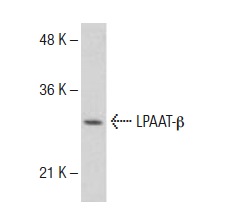
Western blot analysis of LPAAT-β expression in Jurkat whole cell lysate.| Product Name | LPAAT-β Antibody (W-23) |
|---|---|
| Antibody Type | Primary Antibodies |
| Antigen Alias | recommended for detection of LPAAT-β of human origin by WB, IP and ELISA |
| Modification Notes | Phosphatidic acid and lysophosphatidic acid are phospholipids involved in lipid biosynthesis and signal transduction. LPAAT-∫ (lysophosphatidic acid acyltransferase, beta), also known as AGPAT2, BSCL, BSCL1, LPAAB or 1-AGPAT2 (1-acylglycerol-3-phosphate O-acyltransferase 2), is a multi-pass membrane protein localized to the endoplasmic reticulum that catalyzes the synthesis of phosphatidic acid from lysophosphatidic acid. Predominantly expressed in heart and liver, LPAAT-∫ belongs to the LPAAT family of proteins that have a well-known role in lipid biosynthesis. In addition, LPAAT family members may also play a role in tumor progression. Mutations in the gene encoding LPAAT-∫ can result in the autosomal recessive disorder CGL1 (congenital generalized lipodystrophy type 1). CGL1, also known as Berardinelli-Seip congenital lipodystrophy type 1 (BSCL1), is a disorder characterized by insulin resistance, early onset of diabetes, hepatic steatosis, scarcity of adipose tissue and hypertriglyceridemia. |
| Clonality | Polyclonal |
|---|---|
| Isotype | IgG |
| Host Species | Rabbit |
| Tested Applications | WBIPELISA |
| WB:1:500~1:2000 IP:1:100~1:500 Notes:Optimal dilutions/concentrations should be determined by the researcher. |
|
| Species Reactivity | HumanMouseRat |
| Concentration | 1mg/ml |
| Purification | Affinity purified |
| Alternative Names | recommended for detection of LPAAT-&beta of human origin by WB IP and ELISA |
|---|---|
| Tissue Specificity | recommended for detection of LPAAT-β of human origin by WB, IP and ELISA |
| Entrez Gene | 10555 |
|---|
Application
Western blot analysis of LPAAT-β expression in Jurkat whole cell lysate.| Application Notes | WB:1:500~1:2000 IP:1:100~1:500 Notes:Optimal dilutions/concentrations should be determined by the researcher. |
|---|
| Form | Liquid |
|---|---|
| Storage Instructions | For short-term storage, store at 4° C. For long-term storage, aliquot and store at -20ºC or below. Avoid multiple freeze-thaw cycles. |
| Storage Buffer | phosphate buffered saline , pH 7.4, 150mM NaCl, 0.02% sodium azide and 50% glycerol. |


