Application
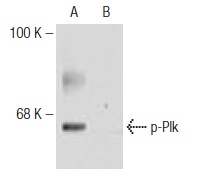
Western blot analysis of Plk phosphorylation in untreated (A) and lambda protein phosphatase-treated (B) rat synaptic membrane tissue extracts.| Product Name | p-Plk Antibody (Thr 210) |
|---|---|
| Antibody Type | Primary Antibodies |
| Antigen Alias | recommended for detection of Thr 210 phosphorylated Plk of mouse, rat, human, Xenopus and zebrafish origin by WB and IP; also reactive with additional species, including bovine and canine |
| Modification | Phosphoralated |
| Modification Notes | Plk (for polo-like kinase) encodes a serine/threonine kinase that is closely related to polo and CDC5, genes that are required for passage through mitosis in Drosophila and Saccharomyces, respectively. Polo and CDC5 both code for proteins that are involved in regulating the function of the mitotic spindle. Plk protein accumulates in the cell during the S and G2 phases of the cell cycle and both protein content and catalytic activity peak at the onset of mitosis, followed by a rapid reduction after mitosis. Plk expression is detectable in mitotically active tissues such as colon and placenta, as well as in tumors of various origins. It has also been suggested that Plk may serve as a marker of cell proliferation. The phosphorylation of mouse, rat and human Plk on Thr 210 enhances Plk catalytic activity. |
| Clonality | Polyclonal |
|---|---|
| Isotype | IgG |
| Host Species | Rabbit |
| Tested Applications | WBIP |
| WB:1:500~1:2000 IP:1:100~1:500 Notes:Optimal dilutions/concentrations should be determined by the researcher. |
|
| Species Reactivity | HumanMouseRat |
| Concentration | 1mg/ml |
| Purification | Affinity purified |
| Alternative Names | recommended for detection of Thr 210 phosphorylated Plk of mouse rat human Xenopus and zebrafish origin by WB and IP also reactive with additional species including bovine and canine |
|---|---|
| Tissue Specificity | recommended for detection of Thr 210 phosphorylated Plk of mouse, rat, human, Xenopus and zebrafish origin by WB and IP; also reactive with additional species, including bovine and canine |
| Entrez Gene | 5347 |
|---|
Application
Western blot analysis of Plk phosphorylation in untreated (A) and lambda protein phosphatase-treated (B) rat synaptic membrane tissue extracts.| Application Notes | WB:1:500~1:2000 IP:1:100~1:500 Notes:Optimal dilutions/concentrations should be determined by the researcher. |
|---|
| Form | Liquid |
|---|---|
| Storage Instructions | For short-term storage, store at 4° C. For long-term storage, aliquot and store at -20ºC or below. Avoid multiple freeze-thaw cycles. |
| Storage Buffer | phosphate buffered saline , pH 7.4, 150mM NaCl, 0.02% sodium azide and 50% glycerol. |


