Application
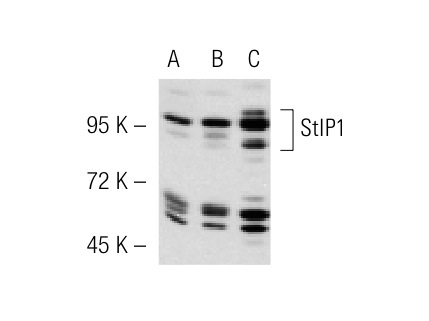
Western blot analysis of StIP1 expression in non-transfected 293T: (A), human StIP1 transfected 293T: (B) and RAW 264.7 (C) whole cell lysates.| Product Name | StIP1 Antibody (S-17) |
|---|---|
| Antibody Type | Primary Antibodies |
| Antigen Alias | epitope mapping within an internal region of StIP1 of human origin |
| Modification Notes | One member of the STAT family, Stat3, participates in a wide range of biological processes including nephrogenesis, gliogenesis, hepatogenesis, T cell proliferation, inflammation and oncogenesis (1-5). Many of these responses are triggered by the IL-6 family of cytokines, which transduce their vital signals through a common gp130 receptor chain (6). A novel Stat3-Interacting Protein, StIP1, contains 12 WD40 repeats, which mediate protein-protein interactions (7). StIP1 exhibits an affinity for members of the JNK family and may play a specific role in regulating Stat3 activation. Overexpression of StIP1 blocks Stat3 activation, nuclear translocation and Stat3-dependent induction of a reporter gene, suggesting that StIP1 regulates the ligand-dependent activation of Stat3, probably by serving as a scaffold protein that promotes the interaction between JNK and the Stat3 substrate. Because StIP1 can associate with several other members of the Stat family, it may serve a broad role in cytokine-signaling events (8). |
| Clonality | Polyclonal |
|---|---|
| Isotype | IgG |
| Host Species | Rabbit |
| Tested Applications | WBIPIFELISA |
| recommended for detection of StIP1 of mouse, rat and human origin by WB, IP, IF and ELISA also reactive with additional species, including equine, canine, bovine and porcine: |
|
| Species Reactivity | HumanMouseRat |
| Concentration | 1mg/ml |
| Purification | Affinity purified |
| Alternative Names | epitope mapping within an internal region of StIP1 of human origin |
|---|---|
| Tissue Specificity | epitope mapping within an internal region of StIP1 of human origin |
| Entrez Gene | 55250 |
|---|
Application
Western blot analysis of StIP1 expression in non-transfected 293T: (A), human StIP1 transfected 293T: (B) and RAW 264.7 (C) whole cell lysates.| Application Notes | recommended for detection of StIP1 of mouse, rat and human origin by WB, IP, IF and ELISA also reactive with additional species, including equine, canine, bovine and porcine: |
|---|
| Form | Liquid |
|---|---|
| Storage Instructions | For short-term storage, store at 4° C. For long-term storage, aliquot and store at -20ºC or below. Avoid multiple freeze-thaw cycles. |
| Storage Buffer | phosphate buffered saline , pH 7.4, 150mM NaCl, 0.02% sodium azide and 50% glycerol. |


