Application
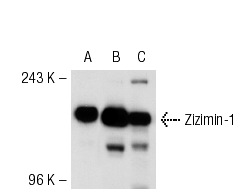
Western blot analysis of Zizimin-1 expression in HEK293 (A) and Caki-1 (B) whole cell lysates and mouse placenta tissue extract (C).| Product Name | Zizimin-1 Antibody (G-18) |
|---|---|
| Antibody Type | Primary Antibodies |
| Antigen Alias | epitope mapping within an internal region of Zizimin-1 of human origin |
| Modification Notes | Zizimin-1, also known as DOCK9 (dedicator of cytokinesis 9), is a 2,069 amino acid protein that localizes to the intracytoplasmic membrane and contains one PH domain, one DHR-1 domain and one DHR-2 domain. Expressed in a variety of tissues with highest expression in placenta and heart and lower expression in lung, kidney, brain and skeletal muscle, Zizimin-1 functions as a guanine nucleotide-exchange factor (GEF) that specifically activates Cdc42 by exchanging bound GDP for free GTP. Four isoforms of Zizimin-1 exist due to alternative splicing events. The gene encoding Zizimin-1 maps to human chromosome 13, which houses over 400 genes, such as BRCA2 and RB1, and comprises nearly 4% of the human genome. Trisomy 13, also known as Patau syndrome, is deadly and the few who survive past one year suffer from permanent neurologic defects, difficulty eating and vulnerability to serious respiratory infections. |
| Clonality | Polyclonal |
|---|---|
| Isotype | IgG |
| Host Species | Rabbit |
| Tested Applications | WBIPIFELISA |
| recommended for detection of Zizimin-1 of mouse, rat and human origin by WB, IP, IF and ELISA also reactive with additional species, including equine, canine, bovine, porcine and avian: |
|
| Species Reactivity | HumanMouseRat |
| Concentration | 1mg/ml |
| Purification | Affinity purified |
| Alternative Names | epitope mapping within an internal region of Zizimin-1 of human origin |
|---|---|
| Tissue Specificity | epitope mapping within an internal region of Zizimin-1 of human origin |
| Entrez Gene | 23348 |
|---|
Application
Western blot analysis of Zizimin-1 expression in HEK293 (A) and Caki-1 (B) whole cell lysates and mouse placenta tissue extract (C).| Application Notes | recommended for detection of Zizimin-1 of mouse, rat and human origin by WB, IP, IF and ELISA also reactive with additional species, including equine, canine, bovine, porcine and avian: |
|---|
| Form | Liquid |
|---|---|
| Storage Instructions | For short-term storage, store at 4° C. For long-term storage, aliquot and store at -20ºC or below. Avoid multiple freeze-thaw cycles. |
| Storage Buffer | phosphate buffered saline , pH 7.4, 150mM NaCl, 0.02% sodium azide and 50% glycerol. |


