Application
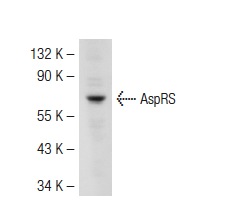
Western blot analysis of AspRS expression in K-562 whole cell lysate.| Product Name | AspRS Antibody (H-300) |
|---|---|
| Antibody Type | Primary Antibodies |
| Antigen Alias | epitope corresponding to amino acids 346-645 mapping at the C-terminus of AspRS of human origin |
| Modification Notes | AspRS (mitochondrial aspartyl-tRNA synthetase), also known as aspartate-tRNA ligase or DARS2, is a 645 amino acid protein that belongs to the class-II aminoacyl-tRNA synthetase family. Localized to the mitochondrial matrix, AspRS exists as a homodimer and functions primarily to aminoacylate tRNA. Also, AspRs contains a 47 amino acid mitochondrial targeting signal, as well as several conserved residues involved in ATP binding, tRNA binding and aspartic acid recognition. The gene encoding AspRS maps to chromosome 1q25.1. Defects in this gene are a cause of leukoencephalopathy with brain stem and spinal cord involvement and lactate elevation (LBSL). LBSL is an autosomal recessive disease characterized by cerebellar ataxia, spasticity and dorsal column dysfunction, sometimes with a mild cognitive deficit. |
| Clonality | Polyclonal |
|---|---|
| Isotype | IgG |
| Host Species | Rabbit |
| Tested Applications | WBIPIFELISA |
| recommended for detection of AspRS of mouse, rat and human origin by WB, IP, IF and ELISA also reactive with additional species, including equine and bovine: |
|
| Species Reactivity | HumanMouseRat |
| Concentration | 1mg/ml |
| Purification | Affinity purified |
| Alternative Names | epitope corresponding to amino acids 346-645 mapping at the C-terminus of AspRS of human origin |
|---|---|
| Tissue Specificity | epitope corresponding to amino acids 346-645 mapping at the C-terminus of AspRS of human origin |
| Entrez Gene | 55157 |
|---|
Application
Western blot analysis of AspRS expression in K-562 whole cell lysate.| Application Notes | recommended for detection of AspRS of mouse, rat and human origin by WB, IP, IF and ELISA also reactive with additional species, including equine and bovine: |
|---|
| Form | Liquid |
|---|---|
| Storage Instructions | For short-term storage, store at 4° C. For long-term storage, aliquot and store at -20ºC or below. Avoid multiple freeze-thaw cycles. |
| Storage Buffer | phosphate buffered saline , pH 7.4, 150mM NaCl, 0.02% sodium azide and 50% glycerol. |


