Application
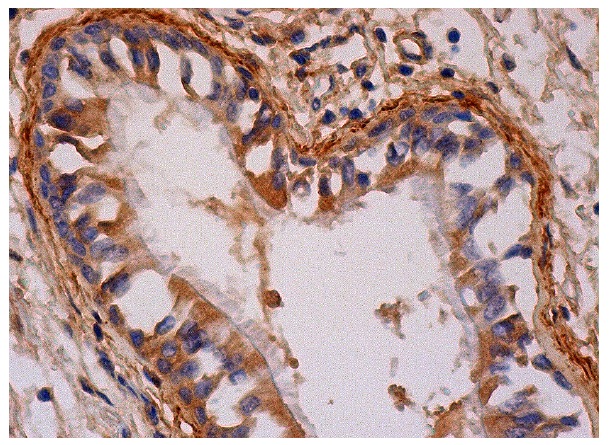
Immunoperoxidase staining of formalin fixed, paraffin-embedded human bronchus tissue showing cytoplasmic staining of respiratory epithelial cells.| Product Name | Periostin Antibody (H-300) |
|---|---|
| Antibody Type | Primary Antibodies |
| Antigen Alias | epitope corresponding to amino acids 537-836 mapping at the C-terminus of Periostin of human origin |
| Modification Notes | Periostin (PN), also designated osteoblast-specific factor 2 (OSF-2), is a disulfide linked protein originally isolated as a osteoblast-specific factor. Periostin is a secreted protein that binds heparin and functions as a ligand for alpha(V)beta(3) and alpha(V)beta(5) integrins. In preosteoblasts, Periostin acts as a cell adhesion molecule and plays a role in osteoblast recruitment, spreading and attachment. Periostin is mainly detected in lower gastrointestinal tract, aorta, stomach, placenta, uterus and breast tissues but is up-regulated in epithelial ovarian tumors and overexpressed in breast cancer. Expression of Periostin is increased by bone morphogenetic protein (BMP2) and transforming growth factor ∫ 1(TGF ∫ 1). Periostin contains a typical signal sequence, followed by a cysteine-rich domain, a fourfold repeated domain, which shows homology with the insect protein fasciclin, and a C-terminal domain. |
| Clonality | Polyclonal |
|---|---|
| Isotype | IgG |
| Host Species | Rabbit |
| Tested Applications | WBIPIFIHCELISA |
| recommended for detection of Periostin of mouse, rat and human origin by WB, IP, IF, IHC(P) and ELISA also reactive with additional species, including bovine and porcine: |
|
| Species Reactivity | HumanMouseRat |
| Concentration | 1mg/ml |
| Purification | Affinity purified |
| Alternative Names | epitope corresponding to amino acids 537-836 mapping at the C-terminus of Periostin of human origin |
|---|---|
| Tissue Specificity | epitope corresponding to amino acids 537-836 mapping at the C-terminus of Periostin of human origin |
| Entrez Gene | 10631 |
|---|
Application
Immunoperoxidase staining of formalin fixed, paraffin-embedded human bronchus tissue showing cytoplasmic staining of respiratory epithelial cells.| Application Notes | recommended for detection of Periostin of mouse, rat and human origin by WB, IP, IF, IHC(P) and ELISA also reactive with additional species, including bovine and porcine: |
|---|
| Form | Liquid |
|---|---|
| Storage Instructions | For short-term storage, store at 4° C. For long-term storage, aliquot and store at -20ºC or below. Avoid multiple freeze-thaw cycles. |
| Storage Buffer | phosphate buffered saline , pH 7.4, 150mM NaCl, 0.02% sodium azide and 50% glycerol. |


