Application
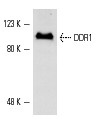
Western blot analysis of non-glycosylated DDR1 mature chain expression in rat brain tissue.| Product Name | DDR1 Antibody (H-126) |
|---|---|
| Antibody Type | Primary Antibodies |
| Antigen Alias | epitope corresponding to amino acids 291-416 mapping within the extracellular domain of DDR1 (discoidin domain receptor 1) of human origin |
| Modification Notes | The majority of the large number of receptor tyrosine kinases that have been identified can be categorized into distinct families based on the structure of their extracellular domains. Only a limited number of ligands for the receptors have been described, and while the majority of the ligands identified are soluble factors, an increasing number of receptors have been shown to bind to cell-surface molecules. Discoidin domain receptor 1 (DDR1), previously identified as Cak, for cell adhesion kinase (and also designated MCK-10, EDDR1, NEP, Ptk-3, RTK6, trk E or NTRK4) and discoidin domain receptor 2 (DDR2) comprise a new family of receptor tyrosine kinases involved in cell-cell interactions. Both DDR1 and DDR2 have been shown to be activated by collagen. Evidence suggests that a docking site for the Shc phosphotyrosine binding domain is phosphorylated in response to activation of DDR1 by collagen, whereas collagen activation of DDR2 results in upregulation of matrix metalloproteinase-1 expression. |
| Clonality | Polyclonal |
|---|---|
| Isotype | IgG |
| Host Species | Rabbit |
| Tested Applications | WBIPIFELISA |
| recommended for detection of DDR1 of mouse, rat and human origin by WB, IP, IF and ELISA also reactive with additional species, including equine, canine, bovine and porcine: |
|
| Species Reactivity | HumanMouseRat |
| Concentration | 1mg/ml |
| Purification | Affinity purified |
| Alternative Names | epitope corresponding to amino acids 291-416 mapping within the extracellular domain of DDR1 (discoidin domain receptor 1) of human origin |
|---|---|
| Tissue Specificity | epitope corresponding to amino acids 291-416 mapping within the extracellular domain of DDR1 (discoidin domain receptor 1) of human origin |
| Entrez Gene | 780 |
|---|
Application
Western blot analysis of non-glycosylated DDR1 mature chain expression in rat brain tissue.| Application Notes | recommended for detection of DDR1 of mouse, rat and human origin by WB, IP, IF and ELISA also reactive with additional species, including equine, canine, bovine and porcine: |
|---|
| Form | Liquid |
|---|---|
| Storage Instructions | For short-term storage, store at 4° C. For long-term storage, aliquot and store at -20ºC or below. Avoid multiple freeze-thaw cycles. |
| Storage Buffer | phosphate buffered saline , pH 7.4, 150mM NaCl, 0.02% sodium azide and 50% glycerol. |


