Application
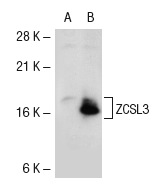
Western blot analysis of ZCSL3 expression in non-transfected: (A) and human ZCSL3 transfected: (B) 293T whole cell lysates.| Product Name | ZCSL3 Antibody (FL-148) |
|---|---|
| Antibody Type | Primary Antibodies |
| Antigen Alias | epitope corresponding to amino acids 1-148 representing full length ZCSL3 of human origin |
| Modification Notes | The CSL-type zinc finger-containing proteins (ZCSLs) are homologs of the S. cerevisiae diphthamide methyltransferase proteins (DPHs). These enzymes are involved in the synthesis of diphthamide, a protein found on translation elongation factor EF-2 that is the target of bacterial ADP-ribosylating toxins. ZCSL1, ZCSL2 and ZCSL3 (CSL-type zinc finger-containing protein 1, 2 and 3, respectively) are members of the ZCSL family of proteins and each contain one DPH-type zinc finger. ZCSL2, also known as DPH3 or DESR1, is highly expressed in spleen, heart, lung, liver and thymus and is essential in the first step of dipthamide synthesis. Down-regulation of ZCSL2 increases the release of proteoglycans, suggesting a possible role in protein secretion. ZCSL1 and ZCSL3, also known as DPH3B and DPH4, respectively, are additional members of the ZCSL family of dipthamide-synthesizing enzymes. |
| Clonality | Polyclonal |
|---|---|
| Isotype | IgG |
| Host Species | Rabbit |
| Tested Applications | WBIPIFELISA |
| recommended for detection of ZCSL3, also designated CSL-type zinc finger-containing protein 3, of mouse, rat and human origin by WB, IP, IF and ELISA also reactive with additional species, including canine, bovine and porcine: |
|
| Species Reactivity | HumanMouseRat |
| Concentration | 1mg/ml |
| Purification | Affinity purified |
| Alternative Names | epitope corresponding to amino acids 1-148 representing full length ZCSL3 of human origin |
|---|---|
| Tissue Specificity | epitope corresponding to amino acids 1-148 representing full length ZCSL3 of human origin |
| Entrez Gene | 120526 |
|---|
Application
Western blot analysis of ZCSL3 expression in non-transfected: (A) and human ZCSL3 transfected: (B) 293T whole cell lysates.| Application Notes | recommended for detection of ZCSL3, also designated CSL-type zinc finger-containing protein 3, of mouse, rat and human origin by WB, IP, IF and ELISA also reactive with additional species, including canine, bovine and porcine: |
|---|
| Form | Liquid |
|---|---|
| Storage Instructions | For short-term storage, store at 4° C. For long-term storage, aliquot and store at -20ºC or below. Avoid multiple freeze-thaw cycles. |
| Storage Buffer | phosphate buffered saline , pH 7.4, 150mM NaCl, 0.02% sodium azide and 50% glycerol. |


