Application
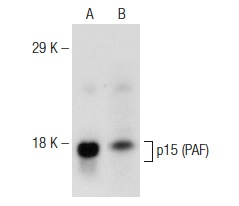
Western blot analysis of p15 (PAF) expression in KNRK nuclear extract (A) and M1 whole cell lysate (B).Application
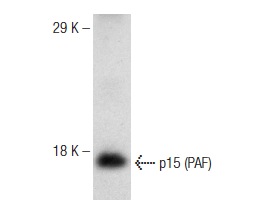
Western blot analysis of p15 (PAF) expression in U266 whole cell lysate.| Product Name | p15 (PAF) Antibody (FL-111) |
|---|---|
| Antibody Type | Primary Antibodies |
| Antigen Alias | epitope corresponding to amino acids 1-111 representing full length p15 (PAF) of human origin |
| Modification Notes | p15 (PAF), also known as PAF, L5, OEATC1 (overexpressed in anaplastic thyroid carcinoma 1) or NS5ATP9, is a 111 amino acid protein that localizes to both the nucleus and the mitochondria. Highly expressed in colon and thymus with lower expression in liver, ovary, kidney, spleen, placenta and small intestine, p15 (PAF) interacts with the nuclear antigen PCNA and, through this interaction, is thought to protect cells from UV-induced cell death. The association of p15 (PAF) and PCNA is enhanced by UV treatment and is facilitated by the binding of ING1, a tumor suppressor that can induce apoptosis. Due to its ability to bind the apoptoic factor ING1 and subsequently decrease the rate of cell death, high levels of p15 (PAF) are found in several types of tumors, including esophageal and pancreatic cancer, suggesting an important role for p15 (PAF) in tumor progression. |
| Clonality | Polyclonal |
|---|---|
| Isotype | IgG |
| Host Species | Rabbit |
| Tested Applications | WBIPIFELISA |
| recommended for detection of p15 (PAF) of mouse, rat and human origin by WB, IP, IF and ELISA also reactive with additional species, including equine, bovine and porcine: |
|
| Species Reactivity | HumanMouseRat |
| Concentration | 1mg/ml |
| Purification | Affinity purified |
| Alternative Names | epitope corresponding to amino acids 1-111 representing full length p15 (PAF) of human origin |
|---|---|
| Tissue Specificity | epitope corresponding to amino acids 1-111 representing full length p15 (PAF) of human origin |
| Entrez Gene | 9768 |
|---|
Application
Western blot analysis of p15 (PAF) expression in KNRK nuclear extract (A) and M1 whole cell lysate (B).
Application
Western blot analysis of p15 (PAF) expression in U266 whole cell lysate.| Application Notes | recommended for detection of p15 (PAF) of mouse, rat and human origin by WB, IP, IF and ELISA also reactive with additional species, including equine, bovine and porcine: |
|---|
| Form | Liquid |
|---|---|
| Storage Instructions | For short-term storage, store at 4° C. For long-term storage, aliquot and store at -20ºC or below. Avoid multiple freeze-thaw cycles. |
| Storage Buffer | phosphate buffered saline , pH 7.4, 150mM NaCl, 0.02% sodium azide and 50% glycerol. |


