Application
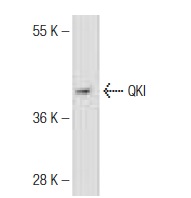
Western blot analysis of QKI expression in Jurkat whole cell lysate.| Product Name | QKI Antibody (U-24) |
|---|---|
| Antibody Type | Primary Antibodies |
| Antigen Alias | recommended for detection of QKI of human origin by WB, IP and ELISA |
| Modification Notes | QKI, also known as HKQ, QK, QK3 or quaking, is a 341 amino acid protein that localizes to both the cytoplasm and the nucleus and contains one KH domain. Expressed in the frontal cortex of the brain, QKI functions as an RNA-binding protein that plays an important role in myelinization and specifically binds to the RNA core sequence 5'-NACUAAY-N(1,20)-UAAY-3'. Additionally, QKI regulates pre-mRNA splicing, and mRNA export and is involved in protecting and promoting the stability of select mRNAs. QKI may be methylated by PRMT1 and may also be phosphorylated at its C-terminus, an event that decreases QKI mRNA-binding affinity. Defects or deletions in the gene encoding QKI are associated with astrocytic tumors and may be involved in the pathogenesis of schizophrenia. Multiple isoforms of QKI exist due to alternative splicing events. |
| Clonality | Polyclonal |
|---|---|
| Isotype | IgG |
| Host Species | Rabbit |
| Tested Applications | WBIPELISA |
| WB:1:500~1:2000 IP:1:100~1:500 Notes:Optimal dilutions/concentrations should be determined by the researcher. |
|
| Species Reactivity | HumanMouseRat |
| Concentration | 1mg/ml |
| Purification | Affinity purified |
| Alternative Names | recommended for detection of QKI of human origin by WB IP and ELISA |
|---|---|
| Tissue Specificity | recommended for detection of QKI of human origin by WB, IP and ELISA |
| Entrez Gene | 9444 |
|---|
Application
Western blot analysis of QKI expression in Jurkat whole cell lysate.| Application Notes | WB:1:500~1:2000 IP:1:100~1:500 Notes:Optimal dilutions/concentrations should be determined by the researcher. |
|---|
| Form | Liquid |
|---|---|
| Storage Instructions | For short-term storage, store at 4° C. For long-term storage, aliquot and store at -20ºC or below. Avoid multiple freeze-thaw cycles. |
| Storage Buffer | phosphate buffered saline , pH 7.4, 150mM NaCl, 0.02% sodium azide and 50% glycerol. |


