Application
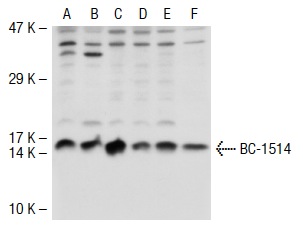
Western blot analysis of BC-1514 expression in HEK293 (A), HeLa (B), U-698-M (C) Raji (D), Ramos (E) and NAMALWA (F) whole cell lysates.| Product Name | BC-1514 Antibody (W-12) |
|---|---|
| Antibody Type | Primary Antibodies |
| Antigen Alias | epitope mapping within an internal region of BC-1514 of human origin |
| Modification Notes | As the smallest human chromosome, chromosome 21 spans just 47 million nucleotides, representing 1.5% of total genetic material in the human genome. Containing between 200 to 400 genes, chromosome 21 has been linked to genetic disorders such as Alzheimer’s disease, Amyotrotrpic lateral sclerosis, Down syndrome and homocystinuria. Translocations of genetic material between other chromosomes and genes residing on chromosome 21 have been associated with several types of cancer, such as acute lymphoblastic leukemia and acute myeloid leukemia. The gene encoding BC-1514 (B lymphocyte activation-related protein BC-1514) contains 1,514 nucleotides and encodes a 130 amino acid protein that was first identified by its expression in human tonsil tissue. The chromosomal location of BC-1514 is very close to a genetic region that is implicated in Alzheimer’s disease, namely 21q21. With highest expression in bone marrow, it is suggested that BC-1514 may play a role in B-cell signal transduction. |
| Clonality | Polyclonal |
|---|---|
| Isotype | IgG |
| Host Species | Rabbit |
| Tested Applications | WBIPIFELISA |
| recommended for detection of BC-1514 of human origin by WB, IP, IF and ELISA: |
|
| Species Reactivity | HumanMouseRat |
| Concentration | 1mg/ml |
| Purification | Affinity purified |
| Alternative Names | epitope mapping within an internal region of BC-1514 of human origin |
|---|---|
| Tissue Specificity | epitope mapping within an internal region of BC-1514 of human origin |
| Entrez Gene | 378829 |
|---|
Application
Western blot analysis of BC-1514 expression in HEK293 (A), HeLa (B), U-698-M (C) Raji (D), Ramos (E) and NAMALWA (F) whole cell lysates.| Application Notes | recommended for detection of BC-1514 of human origin by WB, IP, IF and ELISA: |
|---|
| Form | Liquid |
|---|---|
| Storage Instructions | For short-term storage, store at 4° C. For long-term storage, aliquot and store at -20ºC or below. Avoid multiple freeze-thaw cycles. |
| Storage Buffer | phosphate buffered saline , pH 7.4, 150mM NaCl, 0.02% sodium azide and 50% glycerol. |


