Application
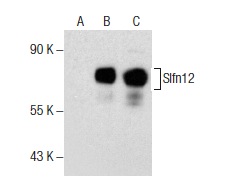
Western blot analysis of Slfn12 expression in non-transfected 293T: (A), human Slfn12 transfected 293T: (B) and Jurkat (C) whole cell lysates.| Product Name | Slfn12 Antibody (G-13) |
|---|---|
| Antibody Type | Primary Antibodies |
| Antigen Alias | epitope mapping within an internal region of Slfn12 of human origin |
| Modification Notes | Schlafen family members are preferentially expressed in lymphoid tissues and are differentially regulated during thymocyte maturation. Schlafen proteins function as suppressors of cell growth and are thought to play a role in the maintenance of T cell quiescence. All members of the Schlafen family contain a conserved core domain and are substantially diversified at the N terminus. The prototype member of the Schlafen family, Slfn1, is transcriptionally unregulated during thymocyte positive selection and its induction leads to G0/G1 arrest, suggesting that Slfn1 participates in the regulation of cell cycle and potentially acts as a determining factor for apoptosis. Slfn1 and Slfn2 are both unregulated during the double-positive (DP) and single-positive (SP) stages of thymocyte development, whereas Slfn4 is down regulated at these stages. Changes in Schalfen protein expression may contribute to phenotypic differences seen in thymic subsets. Slfn12 (schlafen family member 12), also known as SLFN3, is a 578 amino acid protein belonging to the Schlafen family. |
| Clonality | Polyclonal |
|---|---|
| Isotype | IgG |
| Host Species | Rabbit |
| Tested Applications | WBIPIFELISA |
| recommended for detection of Slfn12 of human origin by WB, IP, IF and ELISA non cross-reactive with other Slfn family members: |
|
| Species Reactivity | HumanMouseRat |
| Concentration | 1mg/ml |
| Purification | Affinity purified |
| Alternative Names | epitope mapping within an internal region of Slfn12 of human origin |
|---|---|
| Tissue Specificity | epitope mapping within an internal region of Slfn12 of human origin |
| Entrez Gene | 55106 |
|---|
Application
Western blot analysis of Slfn12 expression in non-transfected 293T: (A), human Slfn12 transfected 293T: (B) and Jurkat (C) whole cell lysates.| Application Notes | recommended for detection of Slfn12 of human origin by WB, IP, IF and ELISA non cross-reactive with other Slfn family members: |
|---|
| Form | Liquid |
|---|---|
| Storage Instructions | For short-term storage, store at 4° C. For long-term storage, aliquot and store at -20ºC or below. Avoid multiple freeze-thaw cycles. |
| Storage Buffer | phosphate buffered saline , pH 7.4, 150mM NaCl, 0.02% sodium azide and 50% glycerol. |


