Application
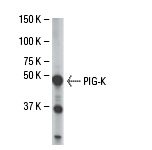
Western blot analysis of PIG-K expression in mouse liver tissue extract.Application
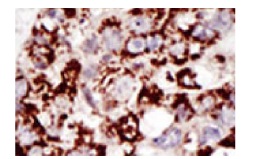
Immunoperoxidase staining of formalin fixed, paraffin-embedded human cancer tissue showing cytoplasmic staining.| Product Name | PIG-K Antibody (C-25) |
|---|---|
| Antibody Type | Primary Antibodies |
| Antigen Alias | recommended for detection of PIG-K of mouse and human origin by WB, IP, IF, IHC(P) and ELISA |
| Modification Notes | Phosphatidylinositol-glycans (PIGs) are multi-pass transmembrane proteins that localize to the endoplasmic reticulum. PIGs exhibit various functions but all are crucial for the biosynthesis of the glycosylphosphatidylinositol (GPI)-anchor. Some PIG proteins are components of the GPI transamidase (GPIT) complex and play a role in the recognition of either the GPI attachment signal or the lipid portion of GPI. Other PIGs belong to the glycosyltransferase complex and function in the transfer of N-acetylglucosamine (GlcNAc) to phosphatidylinositol (PI). A variety of other PIGs play distinct roles in GPI synthesis. PIG-K (also called hGPI8) is the catalytic subunit of GPIT, a multisubunit membrane-bound complex that recognizes the C-terminal signal sequences on proproteins, cleaves them and replaces them with specific GPI lipids. PIG-K functions as a cysteine protease and contains a Cis-His catalytic dyad. It is responsible for cleaving the signal sequence on proproteins and forming the amide bond between GPI and the protein. |
| Clonality | Polyclonal |
|---|---|
| Isotype | IgG |
| Host Species | Rabbit |
| Tested Applications | WBIPIFIHCELISA |
| WB:1:500~1:2000 IP:1:100~1:500 IF:1:200~1:500 IHC:1:50~1:200 Notes:Optimal dilutions/concentrations should be determined by the researcher. |
|
| Species Reactivity | HumanMouseRat |
| Concentration | 1mg/ml |
| Purification | Affinity purified |
| Alternative Names | recommended for detection of PIG-K of mouse and human origin by WB IP IF IHC(P) and ELISA |
|---|---|
| Tissue Specificity | recommended for detection of PIG-K of mouse and human origin by WB, IP, IF, IHC(P) and ELISA |
| Entrez Gene | 10026 |
|---|
Application
Western blot analysis of PIG-K expression in mouse liver tissue extract.
Application
Immunoperoxidase staining of formalin fixed, paraffin-embedded human cancer tissue showing cytoplasmic staining.| Application Notes | WB:1:500~1:2000 IP:1:100~1:500 IF:1:200~1:500 IHC:1:50~1:200 Notes:Optimal dilutions/concentrations should be determined by the researcher. |
|---|
| Form | Liquid |
|---|---|
| Storage Instructions | For short-term storage, store at 4° C. For long-term storage, aliquot and store at -20ºC or below. Avoid multiple freeze-thaw cycles. |
| Storage Buffer | phosphate buffered saline , pH 7.4, 150mM NaCl, 0.02% sodium azide and 50% glycerol. |


