Application
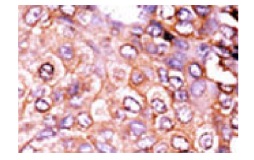
Immunoperoxidase staining of formalin fixed, paraffin-embedded human cancer tissue showing cytoplasmic staining.| Product Name | p-p300 Antibody (Ser 89) |
|---|---|
| Antibody Type | Primary Antibodies |
| Antigen Alias | recommended for detection of Ser 89 phosphorylated p300 of human origin by WB, IP, IF, IHC(P) and ELISA |
| Modification | Phosphoralated |
| Modification Notes | Cyclic AMP-regulated gene expression frequently involves a DNA element designated the cAMP-regulated enhancer (CRE). Many transcription factors bind to this element, including the protein CREB which is activated as a result of phosphorylation by protein kinase A. It has been shown that protein kinase A-mediated CREB phosphorylation results in its binding to a nuclear protein designated CBP (for CREB-binding protein). These findings suggest that CBP has many of the properties expected of a CREB co-activator. Another high molecular weight transcriptional adapter protein, designated p300, is characterized by three cysteine- and histidine-rich regions, of which the most carboxy terminal region specifically binds the adenovirus E1A protein. p300 molecules lacking an intact E1A binding site bypass E1A repression even in the presence of high concentrations of E1A . Sequence analysis of CBP and p300 has revealed substantial homology, arguing that these proteins are members of a conserved family of co-activators. Human p300 may be phosphorylated on specific amino acid residues, including Ser 89. |
| Clonality | Polyclonal |
|---|---|
| Isotype | IgG |
| Host Species | Rabbit |
| Tested Applications | WBIPIFIHCELISA |
| WB:1:500~1:2000 IP:1:100~1:500 IF:1:200~1:500 IHC:1:50~1:200 Notes:Optimal dilutions/concentrations should be determined by the researcher. |
|
| Species Reactivity | HumanMouseRat |
| Concentration | 1mg/ml |
| Purification | Affinity purified |
| Alternative Names | recommended for detection of Ser 89 phosphorylated p300 of human origin by WB IP IF IHC(P) and ELISA |
|---|---|
| Tissue Specificity | recommended for detection of Ser 89 phosphorylated p300 of human origin by WB, IP, IF, IHC(P) and ELISA |
| Entrez Gene | 2033 |
|---|
Application
Immunoperoxidase staining of formalin fixed, paraffin-embedded human cancer tissue showing cytoplasmic staining.| Application Notes | WB:1:500~1:2000 IP:1:100~1:500 IF:1:200~1:500 IHC:1:50~1:200 Notes:Optimal dilutions/concentrations should be determined by the researcher. |
|---|
| Form | Liquid |
|---|---|
| Storage Instructions | For short-term storage, store at 4° C. For long-term storage, aliquot and store at -20ºC or below. Avoid multiple freeze-thaw cycles. |
| Storage Buffer | phosphate buffered saline , pH 7.4, 150mM NaCl, 0.02% sodium azide and 50% glycerol. |


