Application
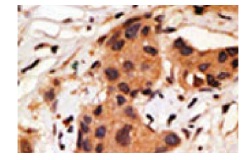
Immunoperoxidase staining of formalin fixed, paraffin-embedded human cancer tissue showing cytoplasmic staining.| Product Name | connexin 59 Antibody (N-24) |
|---|---|
| Antibody Type | Primary Antibodies |
| Antigen Alias | recommended for detection of connexin 59 of human origin by IF, IHC(P) and ELISA |
| Modification Notes | The connexin family of proteins form hexameric complexes called connexons that facilitate movement of low molecular weight proteins between cells via gap junctions. Connexin proteins share a common topology of four transmembrane alpha-helical domains, two extracellular loops, a cytoplasmic loop and cytoplasmic N- and C-termini. Many of the key functional differences between connexins arise from specific amino acid substitutions in the most highly conserved domains: the transmembrane and extracellular regions. Connexin 59, also known as connexin 58, GJA9 (Gap junction alpha-9 protein) or GJA10 (Gap junction alpha-10 protein), is a 515 amino acid multi-pass membrane protein that belongs to the connexin family. Localized to the cell membrane and to gap junctions, connexin 59 functions as part of a connexon complex through which low molecular weight materials diffuse from one cell to another. |
| Clonality | Polyclonal |
|---|---|
| Isotype | IgG |
| Host Species | Rabbit |
| Tested Applications | IFIHCELISA |
| IF:1:200~1:500 IHC:1:50~1:200 Notes:Optimal dilutions/concentrations should be determined by the researcher. |
|
| Species Reactivity | HumanMouseRat |
| Concentration | 1mg/ml |
| Purification | Affinity purified |
| Alternative Names | recommended for detection of connexin 59 of human origin by IF IHC(P) and ELISA |
|---|---|
| Tissue Specificity | recommended for detection of connexin 59 of human origin by IF, IHC(P) and ELISA |
| Entrez Gene | 81025 |
|---|
Application
Immunoperoxidase staining of formalin fixed, paraffin-embedded human cancer tissue showing cytoplasmic staining.| Application Notes | IF:1:200~1:500 IHC:1:50~1:200 Notes:Optimal dilutions/concentrations should be determined by the researcher. |
|---|
| Form | Liquid |
|---|---|
| Storage Instructions | For short-term storage, store at 4° C. For long-term storage, aliquot and store at -20ºC or below. Avoid multiple freeze-thaw cycles. |
| Storage Buffer | phosphate buffered saline , pH 7.4, 150mM NaCl, 0.02% sodium azide and 50% glycerol. |


