Application
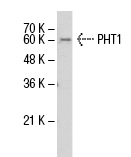
Western blot analysis of PHT1 expression in Hep G2 whole cell lysate.Application
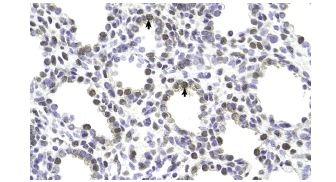
Immunoperoxidase staining of formalin fixed, paraffin-embedded human lung tissue showing nuclear and cytoplasmic staining.| Product Name | PHT1 Antibody (H-22) |
|---|---|
| Antibody Type | Primary Antibodies |
| Antigen Alias | raised against PHT1 of human origin |
| Modification Notes | PHT1, also known as peptide transporter 4, PTR4, hPHT1 or solute carrier family 15 member 4, belongs to a family of peptide transporter proteins known as the Proton-coupled Oligopeptide Transporter (POT) family or the Peptide Transporter (PTR) family. The POT family members are found in mammals, plants, fungi and yeast, and they utilize a proton-dependent mechanism to transport di- and tripeptide-based substrates across the cell membrane. Because peptides are generally hydrophilic and difficult to transport across membrane barriers, insights from the transport pathways of the POT proteins have been used in clinical applications for treatment of many disorders including cancer and hypertension. Localized to the cell membrane, POT proteins contain 12 predicted transmembrane å-helical spans, with a majority of the proteins having intracellular N- and C- termini. PHT1, a 577 amino acid protein, is highly expressed in skeletal muscle and is expressed in low levels throughout the gastrointestinal system, heart, colon and brain. Two isoforms of PHT1 have been identified. |
| Clonality | Polyclonal |
|---|---|
| Isotype | IgG |
| Host Species | Rabbit |
| Tested Applications | WBIPIFIHCELISA |
| recommended for detection of PHT1 of human origin by WB, IP, IF, IHC(P) and ELISA: |
|
| Species Reactivity | HumanMouseRat |
| Concentration | 1mg/ml |
| Purification | Affinity purified |
| Alternative Names | raised against PHT1 of human origin |
|---|---|
| Tissue Specificity | raised against PHT1 of human origin |
| Entrez Gene | 121260 |
|---|
Application
Western blot analysis of PHT1 expression in Hep G2 whole cell lysate.
Application
Immunoperoxidase staining of formalin fixed, paraffin-embedded human lung tissue showing nuclear and cytoplasmic staining.| Application Notes | recommended for detection of PHT1 of human origin by WB, IP, IF, IHC(P) and ELISA: |
|---|
| Form | Liquid |
|---|---|
| Storage Instructions | For short-term storage, store at 4° C. For long-term storage, aliquot and store at -20ºC or below. Avoid multiple freeze-thaw cycles. |
| Storage Buffer | phosphate buffered saline , pH 7.4, 150mM NaCl, 0.02% sodium azide and 50% glycerol. |


