Application
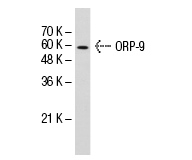
Western blot analysis of ORP-9 expression in Jurkat whole cell lysate.Application
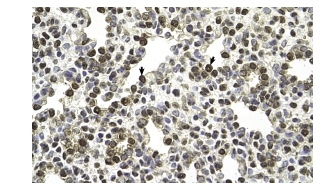
Immunoperoxidase staining of formalin fixed, paraffin-embedded human lung tissue showing nuclear and cytoplasmic staining.| Product Name | ORP-9 Antibody (H-18) |
|---|---|
| Antibody Type | Primary Antibodies |
| Antigen Alias | raised against ORP-9 of human origin |
| Modification Notes | Members of the oxysterol-binding protein (OSBP) family function as intracellular lipid receptors. OSBPs are involved in lipid metabolism and signal transduction, as well as vesicle transport, and can translocate to the periphery of Golgi membranes when they are bound to oxysterols. ORPs (OSBP-related proteins) belong to a subfamily of OSBPs and consists of ORP-1 through ORP-11. The ORPs have a highly conserved OSBP-type sterol-binding region and a pleckstrin homology domain. They strongly bind to phosphatidic acid and weakly bind to phosphatidylinositol 3-phosphate. ORP-9 is widely expressed, and is produced as two isoforms due to alternative splicing. |
| Clonality | Polyclonal |
|---|---|
| Isotype | IgG |
| Host Species | Rabbit |
| Tested Applications | WBIPIFIHCELISA |
| recommended for detection of ORP-9 of human and canine origin by WB, IP, IF, IHC(P) and ELISA: |
|
| Species Reactivity | HumanMouseRat |
| Concentration | 1mg/ml |
| Purification | Affinity purified |
| Alternative Names | raised against ORP-9 of human origin |
|---|---|
| Tissue Specificity | raised against ORP-9 of human origin |
| Entrez Gene | 114883 |
|---|
Application
Western blot analysis of ORP-9 expression in Jurkat whole cell lysate.
Application
Immunoperoxidase staining of formalin fixed, paraffin-embedded human lung tissue showing nuclear and cytoplasmic staining.| Application Notes | recommended for detection of ORP-9 of human and canine origin by WB, IP, IF, IHC(P) and ELISA: |
|---|
| Form | Liquid |
|---|---|
| Storage Instructions | For short-term storage, store at 4° C. For long-term storage, aliquot and store at -20ºC or below. Avoid multiple freeze-thaw cycles. |
| Storage Buffer | phosphate buffered saline , pH 7.4, 150mM NaCl, 0.02% sodium azide and 50% glycerol. |


